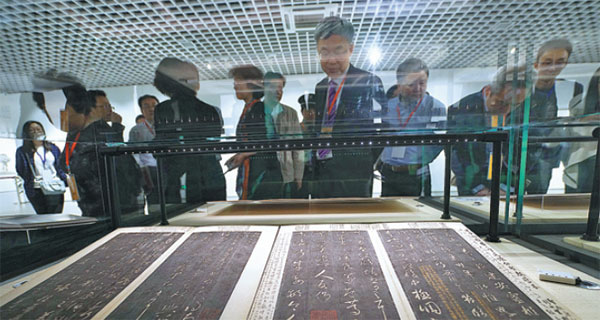
None of 4th-century calligrapher Wang Xizhi's works survive today. But there are facsimiles of masterpieces by him. One of them, which is with Nanjing University in eastern China's Jiangsu province, is part of an ongoing exhibition.
It is among the 100 exhibits being showcased at an exhibition on stone rubbings at an art museum in the university.
The treasured work is a 22-page collection of stone rubbings of 973 characters, and is from Notes of the Daguan Period.
It was complied in the Northern Song Dynasty (960-1027) under an edict, and represent China's technique of using stone craft to duplicate calligraphy.
"We rarely see paper works prior to Song Dynasty today due to the fragility of the paper," says Cheng Zhangcan, a Chinese language professor at the university.
"So, the piece is extremely precious."
Cheng says that the pages are the only remnants in the Chinese mainland of the original Song work rubbed from the Notes of the Daguan Period.
He also says that stone rubbing facsimiles played an important role in passing on Chinese fine art masterpieces over the generations.
"Many original pieces of bronze ware, paintings and calligraphy do not exist," he says. "But stone rubbings show what they were like. Nearly half of the ancient calligraphy masterpieces were passed on this way."
The exhibition, which kicked off on Tuesday runs through May 26. However, the facsimile of Wang's work, which was shown on the opening day, will be shown only once more on Saturday, the 115th anniversary of Nanjing University.
Meanwhile, according to annotations on the scroll, this piece was once owned by celebrated artists, officials and scholars.
In late Qing Dynasty (1644-1911), it was held by Qi Junzao, a teacher to three generations of emperors, and was later found in an antique store in Beijing after the Boxer Rebellion.
John Calvin Ferguson, an American educator, bought it from an antique dealer around 1930 on the condition that it would not be taken out of China.
He donated it to University of Nanking (a predecessor of Nanjing University) in 1934. And the artifact had never been publicly exhibited since then.
Nanjing University now has about 20,000 stone rubbings, one of the most for Chinese colleges.
As the capital city of many dynasties in ancient China, Nanjing also has a huge amount of cultural heritage.
And in its collection of stone rubbings are more than 200 that originated from the city.
For instance, an exhibit rubbed from a stele in the tomb of Xiao Dan, a royal family member from the 5th century, is the only surviving rubbed work from royal tombs in Nanjing during the Northern and the Southern Dynasties (420-589), whose characters remain recognizable today.
Speaking about the university's collection, Zhang Yibin, the Party head of Nanjing University, says: "These stone rubbings are unique and comprise our collective memory."
He says a new museum is been planned to provide better conditions to study, protect and display the rubbings.
Contact the writers through wangkaihao@chinadaily.com.cn
|
The stone rubbings of the Song Dynasty from Notes of the Daguan Period, by 4th-century calligrapher Wang Xizhi, are being shown at Nanjing University. Sun Can / Xinhua |




Copyright 1995 - . All rights reserved. The content (including but not limited to text, photo, multimedia information, etc) published in this site belongs to China Daily Information Co (CDIC). Without written authorization from CDIC, such content shall not be republished or used in any form. Note: Browsers with 1024*768 or higher resolution are suggested for this site.
License for publishing multimedia online 0108263 Registration Number: 130349