Jing Changlin speaks about his family's history and how he has made efforts to share his legacy. Xing Yi reports
The family of Jing Changlin, 79, has been cooking Chinese royal cuisine for three generations.
His grandfather, Jing Hua, was the head chef in the kitchen of the Forbidden City in Beijing.
"He cooked for emperor Guangxu and empress dowager Cixi of the Qing Dynasty (1644-1911)," says Jing Changlin when he speaks about his grandfather.
|
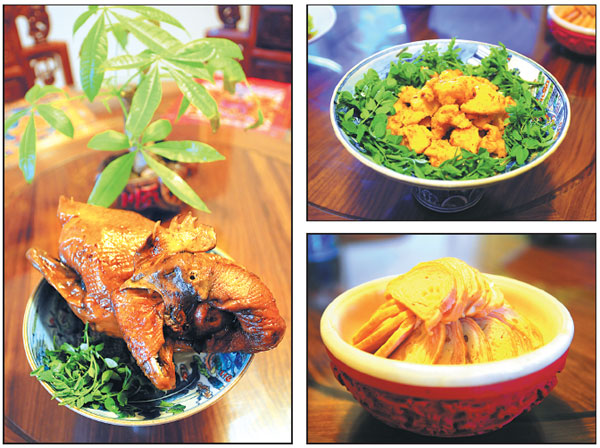
Clockwise from left: Court herbal chicken; fried globefish; Smoky-flavored abalone roll, mixed with fish and chicken skin. Photos by Xing Yi / China Daily |
His grandfather left a book of recipes of the royal dishes.
"I remember reading that book in my childhood, but it is such a pity that the book was lost," he adds.
Jing Changlin's father, Jing Huating, followed the family tradition, learned Chinese cuisine, and later cooked Western cuisine as the Qing Dynasty faded away.
"He was sent to learn Western cuisine at the British American Tobacco Company in Beijing by Li Hongzhang (a minister of the Qing Dynasty who tried to modernize China)," says Jing Changlin.
Jing Changlin, who was born in Beijing in 1938, has three brothers and three sisters, but he is the only one interested in cooking.
"I used to sneak into my father's workplace to taste at the food," he says.
"I used to ask my father to tell me about grandfather's time in the royal kitchen."
Jing Changlin started to cook independently when he went to Zigong, in Sichuan province, in 1966.
There, he taught local chefs how to cook Beijing cuisine, and learned about spicy Sichuan cuisine from them.
The recipes he shared with the Sichuan chefs included sidazhua, or four grab-and-fry dishes.
For that, the chef has to grab a handful of chopped tenderloin, sliced fish, shrimp and pork kidney, he says.
"Deep fry first, then stir fry." The crispness is essential for the success of this dish.
Sidajiang, or dishes made with four fermented sauces, is another recipe Jing Changlin took to Sichuan.
The base of the dish is four fermented sauces - cucumber, hazel, carrot and pea - and it requires the chef to be able to watch the heat in the wok when frying pork chops and other key ingredients.
Jing Changlin returned to Beijing in 1969, and worked as head chef in many high-end hotels.
Then, in 1994, he was recruited by the State General Administration of Sports to plan athlete meals.
"The important thing for athletes is a balanced diet with enough protein and energy," he says.
Despite his many roles over the six decades of cooking, Jing Changlin says that the Chinese royal cuisine is his all-time favorite cuisine.
"It is a mix of local and royal dishes, a blend of Han and Manchu flavors," he says.
The Qing emperors wanted to sample flavors from all over the country, so the royal cuisine comprised 108 dishes, from both northern and southern China.
There were 30 dishes from Zhejiang and Jiangsu, 12 from Guangdong, 12 from Fujian, 30 from Shandong, 12 from Beijing, and 12 from Manchu (the name for Northeast China in the Qing Dynasty).
The dishes involved dozens of cooking methods and a wide range of ingredients and flavors.
"I have studied the royal cuisine for a lifetime," he says. "And I don't want to see it lost."
Jing Changlin has had more than a dozen students over the years, but not everyone keeps cooking.
Not even his son, who has migrated to the US and left the kitchen.
Sun Kaidong is his favorite student.
Sun was born in Shandong province and got to know Jing Changlin in the 1980s when he was working under him in the Beijing Yingzhou Hotel.
There, Sun became his student and learned Chinese royal cuisine.
In recent years, Sun has worked as the executive chef for the New Century Grand Hotel in Beijing, and has even been the secretary-general of the China Royal Chef Association.
Sun has designed more than 120 menus comprising Chinese royal cuisine for different occasions, and also written articles on the health benefits of the royal cuisine.
Sun says: "The cuisine uses no MSG, and all the flavor comes from the food. It is nutritious and is not very expensive to make."
Now, Sun wants to bring the royal cuisine to everybody's dinner table.
"There are a few royal dishes that use rare ingredients such as swallow's nests or bear paws, but it is not like what is depicted in TV dramas," says Sun.
Sun, who studied the dining menu of the Qing Dynasty kept in the Palace Museum several years ago, says: "It (royal cuisine) is more about a way of cooking ordinary farm produce, and royal etiquette."
Contact the writer at xingyi@chinadaily.com.cn




Copyright 1995 - . All rights reserved. The content (including but not limited to text, photo, multimedia information, etc) published in this site belongs to China Daily Information Co (CDIC). Without written authorization from CDIC, such content shall not be republished or used in any form. Note: Browsers with 1024*768 or higher resolution are suggested for this site.
License for publishing multimedia online 0108263 Registration Number: 130349