Tongji University is eager tomake its coursesmore relevant for the new generation. Xu Xiaomin andWang Hongyi report in Shanghai.
Shanghai-based Tongji University is seeking innovative ways to boost its offerings. The university's Party chief Yang Xianjin says that Tongji is also looking for ways to improve its talent cultivation and courses.
Yang says: "As President Xi Jinping called on us to achieve the goal of the great rejuvenation of the Chinese nation and fulfillment of the Chinese Dream, I feel the country has a huge demand for high education and talent.
"And cultivating talented people to meet the country's demand for development has long been a key issue for educators."
The establishment of the Imperial Tientsin University (Peiyang University) in Tianjin in 1895 marked the start of China's high education journey, and during the past 122 years the country has seen remarkable progress.
"China now is an important nation when it comes to education. But as it enters a new era, new types of higher education are needed.
"First, we have a new generation born in the late 1990s and early 2000s who are connected to the internet," says the professor, an experienced university educator and administrator who has been on the campus since his graduation in 1984.
Teaching ideology
Meanwhile, to meet its goal of improving higher education, the 110-year-old Tongji University, which is well-known for its engineering and architecture courses, is looking at social sciences.
In January, the university convened a special meeting to discuss and explore the development of humanities and social science disciplines.
Speaking about the disciplines, he says: "The period between 18 and 22 is the best time in a person's life, and it is an important responsibility for us educators to help these students develop their views of the world and their values. That is why we need to focus on social sciences."
Typically, ideology education is seen as boring by students, and the traditional blackboard teaching style used to teach it is seen as a turn-off.
But Yang says: "It (ideology) should be sprinkled like salt on food, which should blend naturally in the dishes, thus making it more palatable."
So now, instead of using only the blackboard and chalk, teachers in the Tongji University have begun to blend ideology into their courses.
For instance, the university has launched a plan to reform the China's Current Situation and Policymaking course.
Now, teachers use slideshows and video clips, and use current events in their teaching, which has won favor with the students.
Eye on sciences
Separately, the university will focus on developing new courses and departments to be in sync with the country's strategies and changing economic circumstances.
"The top of the list is bioscience, which includes research into stem cells," says Yang, who earned his PhD in biomedical studies from Tianjin University.
Ocean engineering, which includes deepwater studies, is also on the list. "We are working to place 'eyes' under the ocean, which has never been done in the country before," says Yang.
The university has also relocated its lab in marine geology to Shanghai's Lingang port area to facilitate better observation of seabed changes.
As one of the top schools in Shanghai, Tongji University is working to develop courses to meet the demands of the city, which aims to transform itself into a science and technology innovation hub with global influence.
Besides, the university is focusing on green energy, city transportation and railways as well as disaster prevention.
"These (subjects) target important issues for our big cities such as Beijing and Shanghai," says Yang.
"Tongji is renowned for its strong basic research ability, and we also want to focus on industry transformation using these results, so as to better serve society."
In a related development, the university is working with companies such as the Shanghai Automotive Industry Corporation and the China Railway Rolling Stock Corporation, to set up labs and transform research results into tangible products.
Overseas cooperation
Tongji University's history can be traced back to 1907 when the Tongji German Medical School was founded by Erich Paulun, a German doctor in Shanghai.
With a long history of links with Germany, Tongji is now looking for more international cooperation.
To this end, the university has established links with Australia, Austria, Canada, Finland, France, Germany, Japan, Spain, Switzerland, the United Kingdom and the United States in education, science, technology and economics.
Also, Tongji University has been recruiting international students since 1954, and was one of the first universities in Shanghai to offer programs to international students.
In 2016, the university enrolled more than 4,900 international students from 161 countries and regions to pursue their bachelor's, master's and PhD degrees in various disciplines, and to take language courses.
Contact the writers through xuxiaomin@chinadaily.com.cn
|
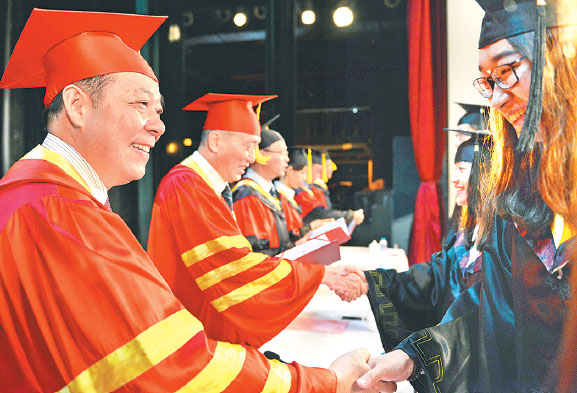
Yang Xianjin, Party chief of Tongji University, delivers diplomas to graduates in Shanghai in June 2016. Photos Provided To China Daily |




Copyright 1995 - . All rights reserved. The content (including but not limited to text, photo, multimedia information, etc) published in this site belongs to China Daily Information Co (CDIC). Without written authorization from CDIC, such content shall not be republished or used in any form. Note: Browsers with 1024*768 or higher resolution are suggested for this site.
License for publishing multimedia online 0108263 Registration Number: 130349