|
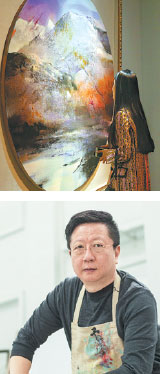
Wang Yancheng shows his abstract oil paintings at a solo exhibition at the National Art Museum of China. Photos By Jiang Dong / China Daily And Provided To China Daily |
Wang Yancheng, 57, sees painting as a process of being in love with the canvas. The artist, who divides his time between Paris and Beijing, says painting is like falling in love with someone, and he feels like he is being integrated with the brush, paint and canvas.
Wang's abstract oil paintings feature masses of vivid colors that offer a sense of grandeur. And many of his works are on show at his ongoing solo exhibition, Yan, at the National Art Museum of China.
The title of the exhibition comes from his given name, which means "evolution" in Chinese.
Wang's works remind viewers of Zao Wou-ki and Chu Teh-chun, two late Chinese-French artists who are known for blending Western techniques with Chinese cultural elements in their creations.
Wang is called an heir to the two artists' legacy because he carries forward an Eastern style that enriches abstract art.
He was introduced to Chu and Zao and deeply influenced by them after he moved to Paris in 1989 to study oil painting.
Then, he further extended their art vocabulary by adding his own thoughts about the mysteries of the cosmos.
Wang says his inspiration comes when he is on a plane and looks down.
A native of Shandong province, Wang's application of colors come from his childhood memories: His parents worked at an oil field and he remembers scenes when the field was enveloped in the grays of dawn and dusk, and the orange hues of sunrise and sunset.
He recreates these impressions on canvas.
Meanwhile, underlying his bold, unrestrained strokes, Wang conveys an emotional attachment to his cultural identity, according to Peng Feng, the exhibition curator.
When Wang entered the University of St. Etienne in France to learn modern painting, he was an ambitious young painter who had garnered fame at home. But his works were criticized by his teachers for lacking in soul. That became a turning point for Wang, and it took him many years to find out what he wanted to communicate, rather than just showcasing his skills.
He then abandoned the realistic, representational style that had won him prizes at home, and he turned to an abstract style through which he sought to convey the philosophical depth of Chinese aesthetics.
"He visualizes the flow of spiritual vitality and surges of life by applying bright colors on a background of overwhelming darkness," says Feng. "And he creates in his works a circulation of energies that empower people's minds, keeping them in harmony with the soil and the universe."
If you go
9 am-5 pm, through April 27. 1 Wusi Dajie, Dongcheng district, Beijing. 010-6400-1476.
linqi@chinadaily.com.cn




Copyright 1995 - . All rights reserved. The content (including but not limited to text, photo, multimedia information, etc) published in this site belongs to China Daily Information Co (CDIC). Without written authorization from CDIC, such content shall not be republished or used in any form. Note: Browsers with 1024*768 or higher resolution are suggested for this site.
License for publishing multimedia online 0108263 Registration Number: 130349