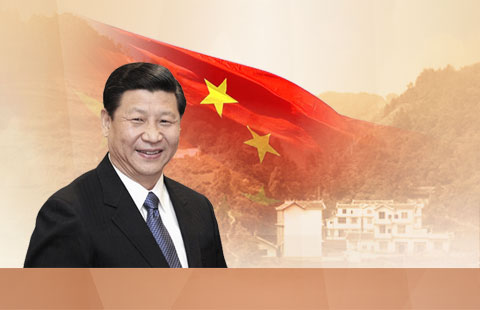
President's speech last year pointed to need for technological breakthroughs
China has made significant progress in the use, governance and security of the internet in the year since President Xi Jinping made a landmark speech at a symposium on cybersecurity and informatization on April 19, 2016, according to experts interviewed by China Daily.
Xi, who is also general secretary of the Communist Party of China Central Committee and chairman of the Central Military Commission, pointed to the need for breakthroughs in core technologies as soon as possible to ensure cybersecurity and safeguard national security.
In his speech, Xi said that "in terms of core technology research and development, alliance between giants is better than fighting on their own". He also called for more cooperation between different cybersecurity enterprises.
The speech put in motion changes at many levels. Internet security expert Xiao Xinguang said the speech changed the way his company does business.
Xiao, founder and chief technology officer at Antiy Labs, a leading internet security firm in China, said that his company started to share analytical reports of security threats with another leading internet security company starting in January.
"After General Secretary Xi raised the question of sharing data in his speech, we took (such cooperation) into consideration," he told China Central Television. He added that sharing such reports with other cybersecurity companies can save costs and improve efficiency.
The high-profile symposium was held as the country's 731 million internet users were getting more say in social governance. Xiao was among 10 people - internet experts, entrepreneurs and officials - who gave suggestions at the meeting.
In his speech, Xi said that the development of the internet in China should meet the people's expectations and demands. He called for more investment in internet infrastructure, especially in rural areas, and said online tools and services should be used to support poverty alleviation campaigns.
"More people in poverty should have access to the internet. They can use it to sell their agricultural products, and their children can receive a high-quality education," Xi said.
The president also called for "more tolerance and patience" toward netizens and welcomed online criticism, "whether mild or fierce", as long as it arises from goodwill.
The emphasis is all part of the growth of informatization, which involves the use of new communications technology to boost society's development, experts said.
Qin An, director at the Institute of the China Cyberspace Strategy, called Xi's emphasis on the role of the people in internet governance significant.
"General Secretary Xi has required officials of all levels to get close to the public through logging on to the internet, because lots of people express their wishes and give their suggestions online," he said.
Xi's central role on internet issues is not new. He headed up the Central Internet Security and Informatization Leading Group, established in February 2014.
"The firm leadership helps guarantee cybersecurity and informatization, key for the nation's long-term development." said Zuo Xiaodong, vice-president of the China Information Security Research Institute.
In the past year, Chinese authorities have made lots of progress not only in cybersecurity governance, but also in the development of internet and international cooperation on cybersecurity, experts said.
In November, the Standing Committee of the National People's Congress, China's top legislature, reviewed and adopted the Cybersecurity Law. In December, the National Cyberspace Security Strategy was released by the Cyberspace Administration of China.
Cybersecurity was also among the issues on the discussion list during the meeting between Xi and his US counterpart Donald Trump in Florida this month. The two leaders later agreed to establish four high-level dialogue mechanisms on diplomacy and security, economy, law enforcement and cybersecurity, and society and culture.
At the Third World Internet Conference in November, Xi's live-broadcast speech to the opening ceremony included a call for the collaborative creation of a cyberspace community of shared destiny.
The online world should be built upon the notions of equality and respect, innovation and development, openness and sharing, and security and order, Xi said.
Fang Xingdong, founder of Chinalabs, an internet strategy think tank, said the concept of the cyberspace community, an idea put forward by Xi, is a core idea for cyberspace development.
"Only when we are open and inclusive and accept each other can we better administer cyberspace," Fang said.
Tang Xujun, director of the Institute of Journalism and Communication at the Chinese Academy of Social Sciences, said: "China is transforming its role from a follower and a peer into a leader in the development of internet information."
Xu Wei contributed to this story.
anbaijie@chinadaily.com.cn




Copyright 1995 - . All rights reserved. The content (including but not limited to text, photo, multimedia information, etc) published in this site belongs to China Daily Information Co (CDIC). Without written authorization from CDIC, such content shall not be republished or used in any form. Note: Browsers with 1024*768 or higher resolution are suggested for this site.
License for publishing multimedia online 0108263 Registration Number: 130349