|
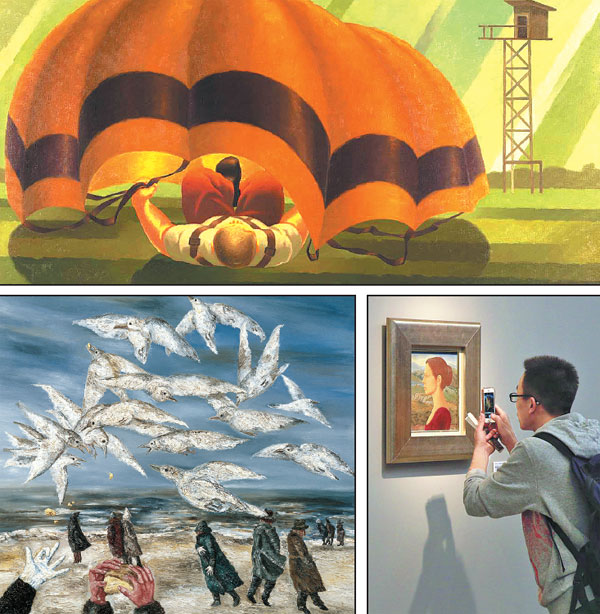
The ongoing exhibition, Voice of the Volga River, at the National Art Museum of China in Beijing, displays oil paintings by Russian artists of the 20th century. Photos By Jiang Dong / China Daily And Provided To China Daily |
The National Art Museum of China is displaying 100 works at an exhibition to show how modern artists revived and interpreted a painting legacy. Lin Qi reports.
Liu Xun (1929-2007) had a productive art career that lasted some six decades, covering lithography, traditional Chinese New Year paintings, comics, ink-brush and oil paintings. But he also collected art extensively. Two years before he died, Liu donated 1,783 artworks to the National Art Museum of China in Beijing.
The donation included his own works and fine paintings and folk art by artists from home and abroad. Among the highlights were 108 Russian canvases from the 20th century.
The museum is now displaying a selection of 90 pieces from this Russian art collection at an ongoing exhibition, Voice of the Volga River, showing how modern artists revived and interpreted the legacy of Russian painting.
Thanks to a close relationship between China and Russia, Chinese oil painting is heavily influenced by the Soviet realistic style.
In the 1950s, many Chinese artists were sent to the former Soviet Union to study oil painting.
And a class taught by Soviet painter Konstantin Maksimov (1913-94) at Beijing's Central Academy of Fine Arts (1955-57) produced New China's first generation of oil painters, including Liu.
Chinese audiences are typically drawn to classic Russian paintings.
In 2015, Moscow's State Tretyakov Gallery exhibited works by the 19th-century Peredvizhniki (Russian for "the wanderers") artists' group at the National Museum of China in Beijing, and the show drew large crowds.
The paintings on show included works by Ilya Repin and Isaac Levitan.
Despite the popularity of Russian art in China, the fans lack a comprehensive understanding of the scope and vigor of modern Russian paintings, especially works that do not follow the dominant Soviet realistic style.
The current exhibition attempts to fill the knowledge gap by focusing on different artists.
Wu Weishan, director of the National Art Museum of China, says the exhibition introduces modern masters who follow the steps of the Peredvizhniki artists, such as Repin and Vsily Surikov, and continue to glorify Russian oil painting in terms of representation and technique.
He says the works show the influence of Russian history and politics, and also the country's natural landscapes.
The first generation of the featured Russian artists were born in the 1920s and 1930s and experienced wars and were active in socialist work. They worked at art universities or government cultural institutions.
They painted with an optimistic and realistic style.
They focused on collective war memories, or landscapes of serenity and daily life, through which they dwelled on subjects like eternity.
Artists born in the 1940s and 1950s encountered systematic and strict discipline at art schools under the first generation. Unlike their teachers, these artists achieved artistic maturity during the transformation of the Soviet Union into the Russian Federation.
Wu says when this generation of painters approached realistic themes, they presented a more personal perspective and used symbolic images and metaphors. They also preferred to dwell on family relationships rather than historical events.
Those born in the 1960s touched on more extensive themes thanks to the impact of modernist movements in Europe and the United States. They communicate diverse values in a gesture that departs from the long-standing realism of Russian painting.
Wu says the characteristics of this generation of painters can also be found in 10 paintings on show, which come from a collection donated by the German collector couple Irene and Peter Ludwig in 1996.
Gao Teng, a retired magazine photographer in Beijing, says the exhibition deserves more than one visit.
He says he was impressed by Russian paintings when he visited Moscow last year. He stayed there for weeks to brush up on his oil painting skills.
During the trip, he also visited art colleges and galleries as part of his "pilgrimage to Russian fine art".
"Every day I went to the woods near where I lived, or the forests in the suburbs, to do sketches and paintings. I was engulfed by the tranquility of the land, and I could also feel that there was an underlying energy that could erupt at any time. This is the soil that produces artists of excellence."
Wu says that in Russian paintings one can feel the sentimental side that defines Eastern aesthetics and a poetic portrayal of country life.
"They (the paintings) harbor a love of the homeland, praise for laborers and the pursuit of what is kind and beautiful."
Contact the writer at linqi@chinadaily.com.cn
If you go
9 am-5 pm, closed on Mondays, through May 7. 1 Wusi Dajie, Dongcheng district, Beijing. 010-6400-1476.




Copyright 1995 - . All rights reserved. The content (including but not limited to text, photo, multimedia information, etc) published in this site belongs to China Daily Information Co (CDIC). Without written authorization from CDIC, such content shall not be republished or used in any form. Note: Browsers with 1024*768 or higher resolution are suggested for this site.
License for publishing multimedia online 0108263 Registration Number: 130349