|
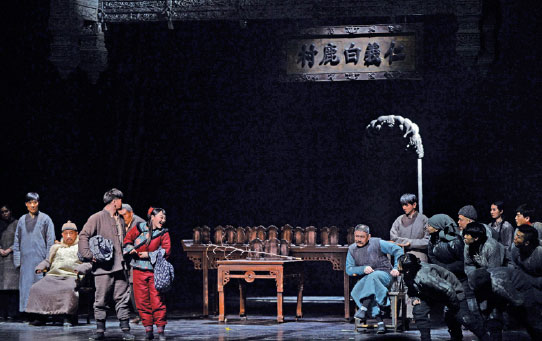
The Shaanxi People's Art Theater's rendition of Bai Lu Yuan features impressive stage sets that are reflective of real-life Shaanxi society. The music is inspired by the traditional Qinqiang Opera. Provided To China Daily |
After wrapping up its performances in Beijing on April 2, the play Bai Lu Yuan (White Deer Plain), will tour other Chinese cities, including Guangzhou, Shenzhen, Nanjing, Shanghai and Suzhou of eastern Jiangsu province, through June.
Adapted from the late Chinese writer Chen Zhongshi's novel of the same title, the play, by Shaanxi People's Art Theater, tells the story of two farming families surnamed Bai and Lu.
It is set in northwestern Shaanxi province in the decades between the fall of the Qing Dynasty (1644-1911) and the founding of New China in 1949.
Published in 1993, the novel won China's top literary honor, the Mao Dun Literature Prize, and it has been hailed by critics as a must-read for those who want to gain a deeper understanding of the country.
Among the book's adaptations, a film with the same title directed by Wang Quan'an won the Silver Bear for best cinematography at the 2012 Berlin Film Festival.
The Beijing People's Art Theater adapted the classic into a play back in 2006. It was directed by eminent Chinese stage director Lin Zhaohua and featured famous actors, including Pu Cunxin and Song Dandan.
Meng Bing wrote the script for the play for both the Beijing People's Art Theater and Shaanxi People's Art Theater. He says the play's current national tour is a commemoration of Chen, who died of cancer at the age of 73 in April 2016.
"To adapt a novel with more than 500,000 words to a three-hour play is quite challenging," says Meng.
Meng has written nearly 100 scripts for TV series, films and plays.
"I visited Chen and talked with him before adapting the novel into a script. And Chen shared his ideas about writing the novel and his analysis of the characters, which was very helpful," he says.
Chen was born in August 1942 in Xi'an, the provincial capital of Shaanxi. He started writing prose in 1965 and completed the novel in 1992.
With its publication in 1993, Chen shot to fame almost overnight. Critics described his works as a "realistic reflection of Chinese contemporary history".
"During the process of adaptation, I mapped out on the wall the relationship of all the characters in the novel, their life experiences and changes against certain period of time in history. I also tried to figure out the personality of each character for the stage presentation," Meng says.
"This novel is timeless and I wanted to display the writer's ideas as much as possible."
The scriptwriter stayed in the province's countryside for weeks while working on his script, trying his hand at farming and eating noodles with the local people. That helped him understand the deep connection between farmers and their land.
The play debuted to a warm reception in Xi'an, in December 2015. Chinese theater critic Li Longyin declared it "the best play of 2016".
"The advantage of the Shaanxi People's Art Theater's rendition of the novel is obvious because the story takes place in Shaanxi. All the actors were from the province and they speak the local dialect, which adds to the play's authenticity," says Meng.
The Shaanxi People's Art Theater also impressed audiences with its stage sets, which reflect real-life Shaanxi society.
Set designer Huang Kaifu drew inspiration from the province's Folk Art Museum, where he saw relics of Qing architecture.
The patterns on doors and sizes of noodle bowls were re-created to look similar to Qing-era objects.
Director Hu Zongqi says that a highlight of the play is the music, which includes elements from Shaanxi's Qinqiang Opera, a typical Shaanxi folk opera known for high-pitched singing. The composer Zhao Xiaodan read the novel many times before creating the music.
"The function of the music is to help convey emotions of people - not just the characters but also the audiences," the director says.
chennan@chinadaily.com.cn




Copyright 1995 - . All rights reserved. The content (including but not limited to text, photo, multimedia information, etc) published in this site belongs to China Daily Information Co (CDIC). Without written authorization from CDIC, such content shall not be republished or used in any form. Note: Browsers with 1024*768 or higher resolution are suggested for this site.
License for publishing multimedia online 0108263 Registration Number: 130349