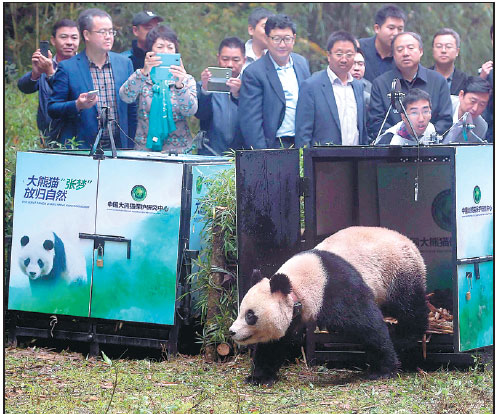
When a panda died after being released into the wild late last year, the Chengdu Research Base for Giant Panda Breeding became the target of criticism. Hesheng, a captive-bred panda, died in September, two months after being released into the wild in Southwest China's Sichuan province, according to an announcement from the research base.
The announcement sparked outcry among netizens, who questioned whether the reintroduction program was protecting or "murdering" the animals.
Experts in the field rejected the claims.
Wild giant pandas inhabit six highly separate mountain systems, leading to frequent inbreeding and an increased risk of extinction.
"We release pandas into the wild to live, mate and breed in an attempt to diversify the species' gene pool," said Zhang Hemin, director of the China Conservation and Research Center for the Giant Panda.
He said captive breeding is used to stabilize the number of pandas, but as a species they belong in the wild.
A member of staff at the base in Chengdu, who preferred not to be named, told Xinhua that releasing pandas back into the wild is a complicated process involving many trials and failures. The death of Hesheng has put the base under a lot of pressure.
In March last year, the male panda started a training period at the Liziping Nature Reserve in Sichuan, and was released into the wild in July.
On Sept 11, Hesheng, who born in 2013, was spotted about 3.5 km from the release point. However, on Sept 27, his GPS collar sent out an alarm, prompting an overnight search.
When researchers found Hesheng's body, they noticed injuries on his right shoulder, right ear and right hind limb. An autopsy confirmed he had died from septicemia due to a bacterial infection after being attacked by unknown animals.
The number of wild pandas has grown steadily in recent years. By the end of last year, there were 1,864, and a further 464 were being cared for in captivity.
Eight pandas have been released into the wild since the reintroduction program began in 2006. Five have survived.
Xiang Xiang, the first panda released, died roughly a year later after fighting with wild pandas for food and territory. Xue Xue, the fourth released, died from an unknown illness a month after being released.
The release is just the beginning, and there are several steps that must be completed before it can be declared a success. The reintroduced pandas need to survive for at least one year to prove they can feed themselves. Then they have to "socialize", create their own territories and be able to mate and breed.
"Pandas are not pets. They should go back into the wild. And the process of captive breeding, wild training and release is a road that must be travelled," Zhang said.
"The reintroduction program is, after all, a scientific experiment that can take as long as several decades. Risks remain, but I believe we can do better in the future."
|
Panda Hua Yan was released into the wild at the Liziping Nature Reserve in Sichuan province in October.Xue Yubin / Xinhua |




Copyright 1995 - . All rights reserved. The content (including but not limited to text, photo, multimedia information, etc) published in this site belongs to China Daily Information Co (CDIC). Without written authorization from CDIC, such content shall not be republished or used in any form. Note: Browsers with 1024*768 or higher resolution are suggested for this site.
License for publishing multimedia online 0108263 Registration Number: 130349