SAN FRANCISCO - A new study suggests that the system of grid cells, known as the brain's global positioning system, is more complicated than anyone had guessed.
Researchers with Stanford University report this week in Neuron that human brains map out the world in a more complex way, with some of the neurons in the internal navigation systems look a lot like speedometers or compasses, many others operate flexibly, each one encoding a dynamic mix of navigational variables, like a compass that somehow transforms into a GPS when driving downtown.
The project began in 2014, when Lisa Giocomo, an assistant professor of neurobiology in the School of Medicine and member of Stanford Bio-X, and Surya Ganguli, an assistant professor of applied physics, got a Bio-X seed grant to take a closer look at how the brain finds its way around.
The findings by then were that while some neurons fell within the ballpark of how a grid cell was supposed to behave, most provided only noisy, error-prone navigation, like a GPS on the fritz. That led the researchers to wonder whether the brain had a way to correct those errors.
By tracking neuron firing in mice as the animals walked around a square box, the Stanford team found that boundary cells help reset wayward grid cells, much like stumbling on a familiar spot helps reorient someone who had been hopelessly lost.
The research team found that only a few fit into any predefined category. "There were all these cell types that didn't have a name," Hardcastle was quoted as saying in a news release. "They weren't grid or border, head direction or speed cells, which are the four main types. This started as an extension of previous work, but then it really took a left turn."
Most neurons that appeared to be grid cells or head-direction cells also tracked speed. Speed cells, meanwhile, were tuned in strange ways: one cell might fire when a mouse moved either quickly or slowly, but not at intermediate speeds. Above all, it was hard to identify any particular set of neuron types, let alone a set that looked like standard navigational instruments. Instead, each neuron seemed to respond a little differently from each other.
Giocomo said one of the take-home messages of the research is that there isn't a good mathematical model for the brain's navigation system.
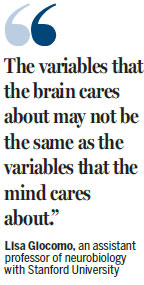
There's a broader issue, she said: "The variables that the brain cares about may not be the same as the variables that the mind cares about. There may be a discrepancy between those."




Copyright 1995 - . All rights reserved. The content (including but not limited to text, photo, multimedia information, etc) published in this site belongs to China Daily Information Co (CDIC). Without written authorization from CDIC, such content shall not be republished or used in any form. Note: Browsers with 1024*768 or higher resolution are suggested for this site.
License for publishing multimedia online 0108263 Registration Number: 130349