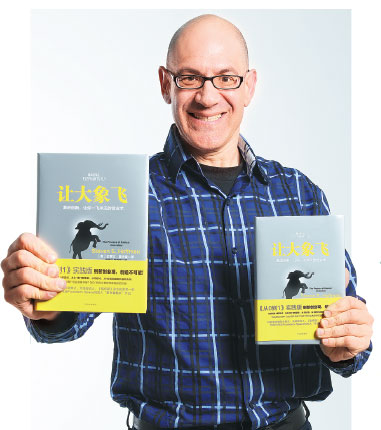
The Chinese version of a veteran US entrepreneur's book, Making Elephants Fly, on the process of innovation with practical advice from Silicon Valley, is on the stands. Xing Yi reports.
Steven Hoffman believes that Chinese startups will play a vital role in shaping the future of the planet.
Recently, the veteran US entrepreneur published a book, Making Elephants Fly, on the process of innovation with practical advice from Silicon Valley.
The Chinese edition hit the shelves in March, but the English edition will not be available until this fall.
"It is unusual," says Hoffman. "While I was talking to business book agents in the US, I told my Chinese friends that I had just finished a book.
"Instantly, I was connected to almost all the top Chinese publishers, and things moved really fast. In China, everything seems to move so fast."
Having created three venture-funded startups in Silicon Valley and trained many corporate executives, Hoffman founded a business incubator in San Francisco in 2012.
The company opened its first overseas branch in Shanghai last September.
Besides giving consultancy, providing shared working spaces, and connecting angel investors with Chinese startups, the Shanghai branch serves as a bridge that helps overseas startups to enter the Chinese market, and the Chinese to go to Silicon Valley.
Last year, Hoffman traveled to more than a dozen major cities in China, meeting business partners and giving lectures to startups.
The experiences in China enabled Hoffman to do some "localization" in the book's Chinese edition.
"I put in special things just for China," says Hoffman. "The core teaching is the same, but there are a lot of Chinese examples."
When speaking about commercialization, Hoffman uses Hiibook to make the point.
Hiibook is a mobile application which gives email a look and function like WeChat, an instant-messaging app, as Chinese businessmen rely heavily on WeChat to communicate and are not used to email, which is, however, widely used in international business.
"They quickly got 10 million downloads in China, but their investor was urging them to add advertisements," Hoffman writes in the book. "This would have been a big mistake. They have to avoid doing things that could harm the growth of users as they are still in an early stage."
Hiibook took Hoffman's advice.
"If we have to balance user experience and profits, we will give emphasis to the former," says Zhou Gongjin, founder of Hiibook. "Now we have no advertisements. Even if we have to monetize our product in the future, we will find a new way that won't damage user experience."
In Hoffman's eyes, the Chinese are natural-born entrepreneurs.
"I've met businessmen in South Korea and Japan, and they are more like big company people, whereas the Chinese will do anything to get a business going - there's no hesitation," says Hoffman.
He also sees a tendency for "quick money" among Chinese businessmen.
"If you want to copy a product, that's great. The Chinese are pretty brilliant at that - take an idea, introduce it to China and run with it," says Hoffman.
"When there was not so much competition, in the days of (Alibaba's) Jack Ma and (Tencent's) Pony Ma, that model worked fine."
But nowadays, there are so many entrepreneurs.
Ever since Premier Li Keqiang called for efforts to boost mass innovation and entrepreneurship at the Summer Davos Forum in September 2014, startups have mush roomed in every corner of the country.
Li said at the news conference following the annual legislative session on March 15 that in the past three years, there were more than 10 million new market entities registered each year.
"They have to innovate, whether they like it or not, or they won't succeed," says Hoffman. "That will actually be good for China, because it will propel China into being a leader in innovation, as opposed to a follower."
"I see that happening right now. That's why I wrote the book and why I am here - to teach the process we follow in Silicon Valley, so that the Chinese can benefit from it and innovate on a global scale."
Mao Daqing, founder of a Chinese business incubator, says Hoffman's book answered many of his questions.
"Hoffman reflects the success of the Valley, and offers valuable lessons for Chinese startups," Mao writes in the book's recommendation.
Besides studying Chinese businesses, Hoffman reads a lot on Chinese history, and finds that China as a society is very good at moving in unison.
"But to really innovate, one has to break away from the pack mentality. People have to force themselves to say: 'No, I am not gonna go where everybody is going, I am gonna go where nobody is going or very few people are going'."
Marching into uncharted territory sounds frightening, and realizing a new idea that the world have never seen is hard.
Hoffman admits that most startups fail, and making a startup succeed is like getting the heaviest animal on earth off the ground.
"Peter Thiel's book Zero to One gives you the big picture, telling you what makes a startup successful," says Hoffman.
"I give you the little picture. I try to go into detail on what are the exact processes to make that breakthrough happen - to make elephants fly."
Contact the writer at xingyi@chinadaily.com.cn
|
Steven Hoffman publishes his latest book, Making Elephants Fly, on the process of innovation with practical advice from Silicon Valley. Provided To China Daily |




Copyright 1995 - . All rights reserved. The content (including but not limited to text, photo, multimedia information, etc) published in this site belongs to China Daily Information Co (CDIC). Without written authorization from CDIC, such content shall not be republished or used in any form. Note: Browsers with 1024*768 or higher resolution are suggested for this site.
License for publishing multimedia online 0108263 Registration Number: 130349