Demand on either side for food and industry items leads to 'remarkable growth in bilateral' imports and exports
With China and the Philippines redefining and improving their bilateral relationship in recent times with a focus on pragmatic business and political ties, fruit merchants, nickel mine owners and machinery manufacturers on either side have started foraying into each others' markets.
The opportunities come from the large Chinese middle class' demand for various agricultural products such as mango and banana as well as aquatic products. This coincides with the Philippines' ongoing infrastructure development and industrialization, which are aimed at boosting production and exports.
In March, China and the Philippines signed company-level trade agreements that committed Chinese businesses to buy $1.7 billion worth of fruits and other agricultural products, as well as mining-related products, from their Philippine counterparts this year.
"We've seen remarkable growth in bilateral trade over the past several months. The two (nations) have agreed to build an industrial park in the Philippines," said Zhong Shan, China's commerce minister.
Trade ministers from both sides met in March during the 28th Philippine-Chinese Joint Commission on Economic and Trade Cooperation, the official bilateral mechanism for discussions on trade, investments and economic cooperation.
Zhao Jianhua, Chinese ambassador to the Philippines, said this is an effort to balance the bilateral trade.
He said the trade agreements were the "advanced result" of Philippine President Rodrigo Duterte's state visit to China in October last year.
The agreements will be the first of many as China also seeks to import more non-food goods such as chemicals and related products.
China has increased its fruit imports such as mangoes and pineapples from the Philippines after Duterte's visit to Beijing.
During the five-month period from November 2016, statistics showed that the bilateral trade has reached $100 million.
Philippine Trade Secretary Ramon Lopez said discussions to further increase trade activities between the two sides and Chinese-funded infrastructure projects are underway and moving forward.
The company-level agreements are an example of thriving bilateral trade relations. They show Philippine goods up for trading include organic coconut products, coco fiber, aqua marine products, ethanol, dried sorghum, garments, textiles, fatty alcohol, fruit, copper cathodes, potassium sulfate, among others.
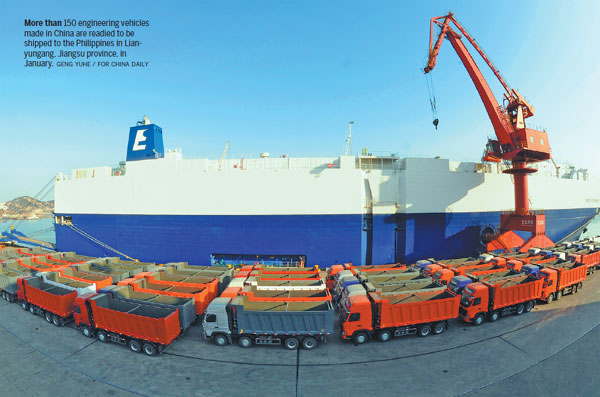
China exports mainly construction machinery, manufacturing equipment, steel, electronics, textiles, garments and household appliances to the Philippines. Chinese-made passenger vehicles and trucks have also become popular in the country.
"The past year has seen a drastic development in our relationship with China. Now, there's no looking back. When we signed the document of the six-year Joint Commission on Economic and Trade Cooperation, we agreed to further strengthen our relationship which will go beyond trading," Lopez said, referring to the agreement signed early March.
The JCETC was convened after a five-year hiatus and serves as a quick follow-through of Duterte's state visit to China.
Lopez and Zhong discussed the six-year Development Program for Economic and Trade Cooperation that will serve as the overall framework for economic relations for 2017-22.
Both sides agreed on important initiatives geared toward improving overall levels of trade and investment between the two countries, the Philippine Department of Trade and Industry said in a statement in March.
China has also committed to finance at least three infrastructure projects in the Philippines worth $3.4 billion, two of which could be rolled out in the first half of this year, according to the Ministry of Commerce.
Trade ties aside, Philippine tour operators are also optimistic that more than 1 million Chinese travelers will travel to the nation this year, thanks to the easing of tourist visa procedures, opening of new hotels and anticipated increase in flights.
Stephen Techico, chairman of Philippine travel agency Uni-Orient Travel Inc, observed "a noteworthy change of perception" among Chinese tourists amid stronger diplomatic and economic ties between the two countries.
"The growth is palpable," Techico said, when the China-ASEAN Year of Tourism was kicked off in Manila, the Philippine capital, in March.
China and ASEAN are each other's largest overseas tourist destinations and largest sources of tourists, and more than 2,700 flights shuttle between both sides each week, said Jiang Yiyi, director of the International Tourism Development Institute, which is under the China Tourism Academy.
"China hopes to work with ASEAN countries to further facilitate travel, strengthen promotion of tourist resources and expand mutual investment in tourism," said Jiang.
The Philippine government recorded an increase of more than 250 percent in Chinese visa applications in the first two months of this year. It also plans to allow Chinese tourists to obtain a visa on arrival for their trips for the rest of this year.
Jiang believes a visa-free policy would be more appropriate and efficient as the procedure of visa on arrival may create hassles for tourists and could affect airport operations.
"The two countries need time to figure out the best practices through continuous communication and cooperation," said Jiang.
zhongnan@chinadaily. com. cn
|
More than 150 engineering vehicles made in China are readied to be shipped to the Philippines in Lianyungang, Jiangsu province, in January. Geng Yuhe / For China Daily |




Copyright 1995 - . All rights reserved. The content (including but not limited to text, photo, multimedia information, etc) published in this site belongs to China Daily Information Co (CDIC). Without written authorization from CDIC, such content shall not be republished or used in any form. Note: Browsers with 1024*768 or higher resolution are suggested for this site.
License for publishing multimedia online 0108263 Registration Number: 130349