After spending two decades planting trees in the Kubuqi Desert in Northwest China, Wang Wenbiao has led his company overseas to reclaim land in countries such as Saudi Arabia and Pakistan.
Wang, president of the China Elion Resources Group, plans to turn the five major deserts in Pakistan, including the Cholistan and Thal deserts, into oases by introducing ecological systems and environmental infrastructures.
The company's techniques reclaim land by promoting vegetative cover, planting forests, controlling desertification and developing weather-resistant cultivable land. Meanwhile, the living standards of local residents are improved via cattle-breeding, herb cultivation and tourism.
"These are the successful experiences summarized in our practices in the Kubuqi Desert in the past 29 years," Wang said. "Currently, we are approaching the authorities to make plans to promote 'green' projects in countries such as Pakistan and Saudi Arabia."
Since 1988, Wang has led the company's anti-desertification projects in the Kubuqi Desert - the seventh-largest in China - in the Inner Mongolia autonomous region. As a result, more than 6,000 square kilometers, or about one-third, of the desert is now "green" again.
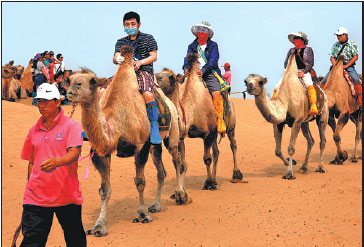
In nearly three decades, the company has treated ecological restoration as an industry, which has brought many business opportunities, he said, noting that an eco-city has been developed in a previously barren wasteland via industries such as desert tourism, herb cultivation and photovoltaic power generation, which are worth a combined 30 billion yuan ($4.3 billion).
The success of the company's operations has provided funding for desertification-control efforts in the Kubuqi Desert, fueling the growth of the economy, society and ecology, he said.
Since 2013, China has been promoting the Belt and Road Initiative, whose routes are scattered across 60 countries, 36 of which face the risk of desertification, according to a proposal Wang recently put to the Chinese People's Political Consultative Conference. For example, more than 1,300 km of the 3,000-km China-Pakistan Economic Corridor runs through both a cold plateau and desert regions.
"It's time for us, the entrepreneurs, to support calls from the central government by doing the things we are good at," he said. "Our successful models have helped to promote best practices for ecological restoration, and we are keen these are now shared with other developing countries struggling with encroaching sand along the routes of the Belt and Road Initiative."
Many international organizations, including the UN Environment Program, have listed a number of desertification protection methods created and adopted by Elion Resources in the Kubuqi Desert as effective global examples, according to the Kubuqi Action Plan of Global Desertification Control (2015-25), which is supported by the World Bank and other groups.
"We hope we can do more to help countries along the Belt and Road initiative," Wang said.
zhengjinran@chinadaily.com.cn
|
Tourists ride camels in the Kubuqi Desert.Ge Jun / For China Daily |




Copyright 1995 - . All rights reserved. The content (including but not limited to text, photo, multimedia information, etc) published in this site belongs to China Daily Information Co (CDIC). Without written authorization from CDIC, such content shall not be republished or used in any form. Note: Browsers with 1024*768 or higher resolution are suggested for this site.
License for publishing multimedia online 0108263 Registration Number: 130349