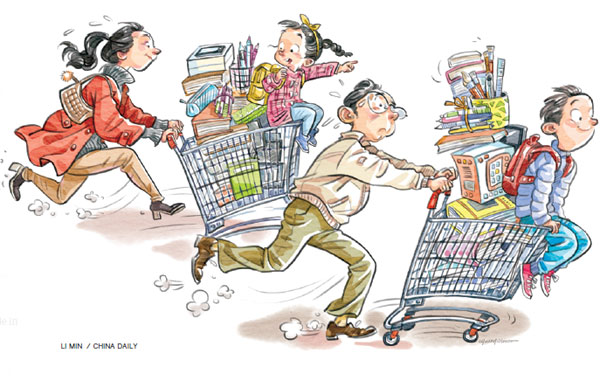
After spending handsomely to celebrate Spring Festival, Chinese couples are preparing to spend yet more extravagant amounts on their children's education at the beginning of the new semester.
Every year before the start of a new semester, prices of several learning devices and materials increase, even double. From digital watches and other fancy learning devices to stationery and books, some parents spend about 2,000 yuan ($291.4) on a child. Those parents who can afford them, and there are many who can, prefer to buy imported high-end study materials for their children that on average cost 1,000 yuan more than those made in China.
The choice of those parents is partly influenced by their belief that expensive learning materials are better quality, and thus can help their children edge ahead in the academic race.
But parents need not spend such huge amounts on expensive equipment, because there is no foolproof evidence to show more expenditure necessarily leads to better academic performance.
Parents should choose study materials that are safe, practical, convenient and simple. Parents should not choose expensive materials simply because they appear novel or have many functions, as by doing so they will not only increase the family's economic burden, but also unwittingly prompt their children to indulge in comparisons and even divert their attention from studies.
The average amount Chinese parents spend on raising a child may give an idea of the financial burden on a family when it comes to education. But then Chinese parents have always been known to spend generously on their children's education. And their expenses have risen with the establishment of new schools, new facilities and extracurricular studies.
Chinese parents, according to some reports, spend at least 250,000 yuan on a child's education before he/she passes out of college. Official data showed that in 2016, the average disposable income of Chinese people was 23,821 yuan ($3,470), which means parents spend more than 10 years of their annual disposable income on a child's education.
Perhaps it is time for parents to reconsider the amount they spend on the expensive learning materials, and realize the role frugality in society's healthy development. Frugality and modesty, as history tells us, have always helped individuals and nations to prosper, whereas extravagance has ruined them. In fact, parents and teachers should also teach children the importance of rational consumption.
But teaching children the virtue of frugality does not mean they should be taught miserliness. Nor does it mean that parents should act miserly. It is only to suggest that parents should spend rationally on their children's education, instead of blindly following the trend of spending extravagantly.
The best education tools for children are those that best meet their needs, not the fancy, expensive study materials. And parents should always focus on what learning materials will really promote the healthy development of their children.
The author is a writer with China Daily.




Copyright 1995 - . All rights reserved. The content (including but not limited to text, photo, multimedia information, etc) published in this site belongs to China Daily Information Co (CDIC). Without written authorization from CDIC, such content shall not be republished or used in any form. Note: Browsers with 1024*768 or higher resolution are suggested for this site.
License for publishing multimedia online 0108263 Registration Number: 130349