A Chinese architect returns to her homeland to discover the spirit of its vernacular architecture
When Pu Xiaoyi studied architecture in Canada and the United States, she often encountered a question: What are the most typical examples of Chinese architecture?
This pushed Pu to undertake a yearlong project to investigate in depth the myriad types of Chinese vernacular building styles throughout the country.
Her findings are presented in the book Chinese Vernacular Buildings.
|
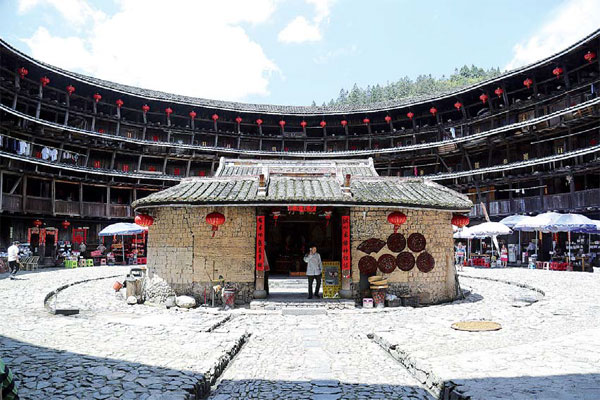
The Hakka people's tulou - circular, fortified earthen buildings in Fujian province. |
The book was published in November by Foreign Languages Press. An English version is expected later this year.
Pu's mission started in 2015. She visited such structures as yaodong, or cave houses, in Northwest China's Shaanxi province; the Hakka people's tulou, which are typically circular, fortified earthen buildings, in East China's Fujian province; and diaojiaolou, the suspended wooden houses in villages belonging to the Miao ethnic group in Southwest China's Guizhou province.
"Vernacular buildings are prototypes of human architecture," Pu said at a talk at the Yale Center Beijing on Jan 8.
"They cater to residents' material, social and spiritual needs. They are wondrous creations by ordinary people."
The book describes Pu's theory of the "triple-coupling nature of mankind" that examines vernacular buildings through the lenses of physical, sociological and spiritual natures. She explains how these dimensions influence the way people in certain places construct and occupy buildings.
Cave dwellings, for instance, evolved largely because of northern Shaanxi's mountainous topography. The peaks in the areas they occupy shield against sandstorms. The caves insulate people against the elements, as they're cool in summer and warm in winter, compared with the weather outdoors.
The Hakka tulou serve not only functions of defense, but also of interaction among kin, since the large structures often house extended families.
Pu is concerned about the future of such multifunctional vernacular residences. She has discovered most inhabitants are elderly, since many youth migrate from villages to cities to work and live.
She was mistaken as a potential buyer when she visited Anhui province's traditional courtyard homes. The researcher was taken to a "scrapyard" where such houses had been dismantled and their pieces sold as decorations for modern urban homes.
"Even if those houses were transported to cities and reassembled as resorts or clubs for the rich, their links to the land would be severed," Pu says.
That is, their vernacular nature and the connection to local cultures they were built to serve would be undermined.
Pu was born in Beijing in 1989 and shares a special connection with - and concern for - the capital's traditional siheyuan, or quadrangular-courtyard homes, and hutongs - the small alleys and lanes - that serve as cultural symbols of the city.
"When I went to high school in an old hutong area, I saw the sign "chai" (slated for demolition) on the walls of many courtyards," Pu says.
"It made me very upset."
Pu enrolled in McGill University in Montreal, Canada, in 2008.
She admires the conservation of the city's historic district, where some buildings date back to the 17th century.
Pu once worked as an intern in the office of renowned Japanese architect Kengo Kuma and recalls that Kuma told her that architects should seek roots from their own traditions to guide design.
After graduating from McGill, Pu was admitted to the Yale School of Architecture in 2013.
Her proposal for the project to study Chinese vernacular architecture was supported by her adviser, professor James von Klemperer, who's also the president and design principal of one of the world's largest architecture firms, Kohn Pedersen Fox Associates.
"Such a scholarship is especially meaningful at this time in the development of Chinese urban centers," Klemperer writes in a recommendation of Pu's book.
"We are reminded of the value of the past both as encouragement to preserve its heritage but also (as) a guide to inform the patterns of future growth."
xingyi@chinadaily.com




Copyright 1995 - . All rights reserved. The content (including but not limited to text, photo, multimedia information, etc) published in this site belongs to China Daily Information Co (CDIC). Without written authorization from CDIC, such content shall not be republished or used in any form. Note: Browsers with 1024*768 or higher resolution are suggested for this site.
License for publishing multimedia online 0108263 Registration Number: 130349