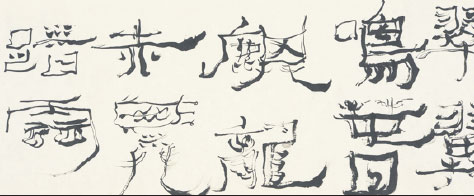
The centerpiece of experimental calligrapher Wei Ligang's ongoing Beijing exhibition is a 45-meter-long scroll titled Phoenixes and Dragons that the Beijing-based artist completed in 2012.
In the work, Wei repeats classical poetry and original verses. He cycles through various writing styles, including the cursive script (caoshu) and clerical script (lishu). The brushstrokes transform in a symphonic way "abruptly from calmness to a manic touch", says Wei.
The piece is installed on the wall and in a spiral on the second floor of Ink Studio Beijing, where Wei's exhibition Songs of Phoenix Mirror is running.
The characters are like mythical birds in ancient Chinese tales, taking viewers on a journey through time to the origin of Chinese aesthetics.
The 53-year-old grew up in Datong, a city in North China's Shanxi province that boasts rich historical and cultural heritage.
Once a capital of the Northern Wei Dynasty (386-534), Datong is celebrated for its ancient Buddhist sites, including the Yungang grotto shrines and the Huayan Temple, and many precious steles bearing calligraphic inscriptions from centuries ago.
The environment implanted in him a deep admiration for the grandeur and power of classical art. Wei, who began practicing calligraphy as a child, is inspired by such masters as Fu Shan (1607-84), a famed calligrapher, thinker and doctor from Taiyuan, Shanxi's provincial capital.
Wei's calligraphic pieces show the influence of Fu's writing philosophy - seeking a state that is a bit out of control.
Wei, who majored in mathematics at Nankai University in Tianjin, has been passionate about calligraphy since college. He immersed himself in the research of Fu and Chinese epigraphy.
Wei, who moved to Beijing in 1995 to become a professional artist, has since sought to engage in contemporary art to renew Chinese calligraphy.
His works explored Fu's ideas in a modern context.
"Fu personifies the characters of calligraphy. He is opposed to a showcase of skillful cleverness and sophistication, as well as compositions that cater to mainstream tastes," he says.
"If one seeks security and remains in his comfort zone, he cannot create a good piece of work.
"A master loves the uncontrolled feeling. Even when he makes mistakes by going too far, he knows how to fix the imperfections with a perfect finish."
The works on show feature Wei's signature "magic square" characters.
He exaggerates the structures of the characters, making them look like ballooned squares pressed against each other.
His characters are inspired by inscriptions on oracle bones and Northern Dynasty (386-581) steles.
Between the characters he adds images of flowers, birds, towers and gates. By doing so, he distracts viewers from the characters so they can see the beautiful variations of their lines.
Wei - who writes on a golden acrylic background or uses golden acrylic pigments on black paper - makes the characters pop up. The visual effect reminds viewers of the artistic splendor of the Han (206 BC-AD 220) and Tang (618-907) dynasties.
"When I write, I can see the characters rise and fly in the sky like free birds."
If you go
10 am-6 pm, closed on Mondays, through Feb 12. Red No 1-B1, Caochangdi, Chaoyang district, Beijing. 010-5127-3143.
linqi@chinadaily.com.cn
|
Phoenixes and Dragons, a calligraphic piece by Wei Ligang, is among the works at an ongoing exhibition in Beijing. Provided To China Daily |




Copyright 1995 - . All rights reserved. The content (including but not limited to text, photo, multimedia information, etc) published in this site belongs to China Daily Information Co (CDIC). Without written authorization from CDIC, such content shall not be republished or used in any form. Note: Browsers with 1024*768 or higher resolution are suggested for this site.
License for publishing multimedia online 0108263 Registration Number: 130349