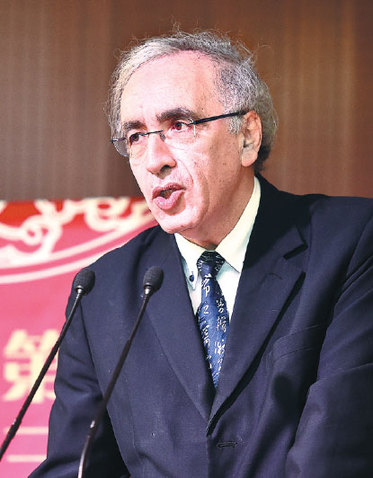
Sinologist Joel Bellassen, who recently won the Huilin Cultural Award, explains why he sees a bright future for the language across the globe. Wang Kaihao reports.
A look at this man's WeChat account could lead you to think that he's a Chinese who loves trying out regional cuisines and touring the country to study traditional culture.
But Joel Bellassen - better known by his Chinese name, Bai Lesang - is a French Sinologist and professor of Chinese at the Paris-based National Institute for Oriental Languages and Civilization.
He first came to China as a student in 1973 and stayed in the country until 1975.
Then, he not only visited the metropolises but also experienced life in the countryside and factories.
He soon fell in love with the Chinese language, an unconventional thing at that time.
"Then, I was a lonely friend of the Chinese language in France," the 67-year-old says.
"But today people in France are enthusiastic about learning the square characters, and I'd like to build a bridge for them."
According to Bellassen, the first inspector-general of Chinese language teaching at the French ministry of education, there are now more than 100,000 Chinese-language learners in France, making it the leader in Europe.
Speaking about winning the Huilin Cultural Award - an annual prize given by Beijing Normal University to those who make extraordinary contributions to cultural communication - Bellassen, who was in Beijing recently to receive the prize, says: "It (the award) is a review of what I've done and reminds me of what remains to be done."
As for what he has done, the list is extensive.
For instance, in 1989, he published Initiation to Chinese Language and Writing, which is still one of the key textbooks used to teach Chinese in French schools.
The book broke the mold for Chinese textbooks by deconstructing the use of the language into single Chinese characters and teaching multi-character words and grammar later.
Oliver Guyonvarch, Bellassen's student and a counselor at the French embassy in Beijing, echoes the Sinologist's belief in the importance of studying individual characters. "That also triggers me to research oracle-bone scripts, which helps me better know the history behind each character," he says.
Bellassen says: "China's ideographic characters belong to a different system. This demands a different methodology when it comes to teaching."
"Also,Western culture - rooted in ancient Rome's traditions - is good for eloquence. But Chinese culture focuses on writing, with a unique art form known as calligraphy.
"So,Western and Chinese cultures are complementary, just like yin and yang."
Wang Song, an official with the State Administration of Foreign Experts Affairs, also says Bellassen was bestowed the award because he has published 38 monographs on Chinese-language teaching and86 theses on the promotion of the language and Sino-French cultural cooperation.
Bellassen says Chinese educators must retain the uniqueness of the writing system when teaching Chinese to overseas students.
"Sometimes, teachers in China tend to mimic the methodologies of Western languages. But it is better to have confidence in your own cultural uniqueness," he says.
Bellassen also says that technology now offers new opportunities to learn Chinese.
"The computer era is changing the way we learn languages. Chinese is a dramatic example. Learning an ideographic language via pinyin, using the (Roman) alphabet, is revolutionary," he says.
"And with new apps helping Chinese learners,we need keep pace and develop even newer methods.
"Knowing Chinese is a trump card for job hunters from overseas because it is now an international language."
But economic growth is not the only impetus for the development of Chinese.
"For instance, in France,many parents see learning Chinese as a way to develop the intelligence of their children."
Bellassen also sees cultural similarities between France and China boosting the popularity of Chinese in France.
"Both China and France have always attached great importance to historical studies and literary pursuits since ancient times," he says.
"Learning Chinese is similar to studying philosophy, which involves metaphysical thinking and thus builds the foundation to understand other aspects of Chinese culture, like cuisine and poetry."
Meanwhile, Bellassen's horizons have expanded far beyond his home country.
In 2015, he founded the European Association for Chinese Teaching, headquartered in Paris.
The first plenary seminar of the association will be held in Budapest, Hungary, from Feb 10 to 12. Chinese educators from more than 20 countries across Europe will gather to share their experiences and concerns.
"A key target of the seminar is to draft a detailed report on the status of Chinese learning in Europe, for possible release in early 2018," he says.
"Then, we can map tailored strategies for different countries."
Contact the writer at wangkaihao@chinadaily.com.cn
|
Joel Bellassen speaks at the award ceremony in Beijing upon winning the Huilin Cultural Award. Provided To China Daily |




Copyright 1995 - . All rights reserved. The content (including but not limited to text, photo, multimedia information, etc) published in this site belongs to China Daily Information Co (CDIC). Without written authorization from CDIC, such content shall not be republished or used in any form. Note: Browsers with 1024*768 or higher resolution are suggested for this site.
License for publishing multimedia online 0108263 Registration Number: 130349