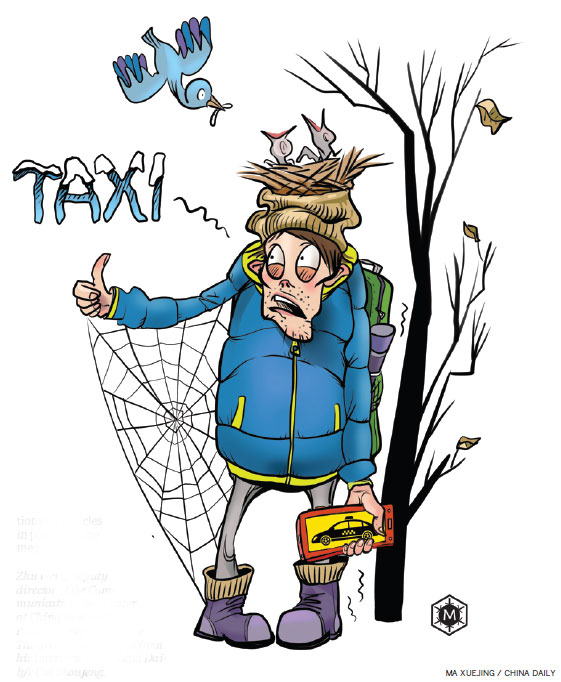
This year's travel rush during Spring Festival, or chunyun, reached its peak days before the Chinese New Year, with passengers finding it particularly hard to hail a taxi or ride-sharing car. In most cases one had to pay drivers extra money to be picked up by ride-sharing cars; and even these offers were at times unanswered, fueling concerns that drivers were "spoiled" by Didi Chuxing, the most popular mobile transportation services platform, and its rivals and now they only take passengers offering generous bonuses.
In response to the mounting complaints by passengers who could not get a car-hailing ride without doubling even tripling the fare, Didi announced before the Lunar Year that it will "temporarily and progressively" ban its registered drivers from collecting the "dispatching fee" as a bonus. Passengers are still free to offer drivers tips.
Ostensibly the hard-to-get cabs are a result of insufficient supply especially while the demand is rising. A number of cities including Beijing and Shanghai enacted rules recently requiring drivers hired by car-hailing platforms to have a local household registration and local license plates for their cars.
That excluded almost 90 percent of the ride-sharing cars, and explains why passengers did not feel the same pain during the Spring Rush last year. In Beijing's case, just 10 percent of the Didi drivers are local permanent residents, and non-local drivers are now disqualified from applying for the car-hailing driving tests, which all drivers now have to pass to be part of the business.
Aside from the restricted access to the car-hailing market, it is also noteworthy that many of the "greedy" drivers obsessed with "value-added" trips work for traditional taxi companies. For long, the government guided-price for taxi fare has been unreasonably low, showing little respect for the market-oriented demand-supply balance. Plus the monthly operations and franchise fees charged by the cab companies, taxi drivers are motivated to seek, and in some cases, abuse the right to solicit a bonus while they can.
The truth is, ride-hailing vehicles and taxis are not a "high-end" supplement to urban public transportation but a key element of it, given they offer tailored services.
That said, local governments should refrain from fixing taxi fares; they should scrap the so-called government guided-price and set an upper limit instead. That some taxi drivers demand higher pay through car-hailing platforms, to some extent may force a market-based price reform in the industry, because administrative orders have failed to keep taxi fares at reasonable levels in previous years.
On the other hand, regulating the car-hailing services need not come at the cost of transportation efficiency. Unlike traditional taxi enterprises, car-hailing platforms do not own any vehicles and adopt totally different standards of fixing prices and hiring employees. Their emergence not only helps reduce traffic congestion as all "taxis" hit the road only when they have a nearby order, but also save car owners the trouble of parking and avoiding the odd-even plate restrictions on vehicles in place in some mega-cities.
Zhu Wei is deputy director of the Communication Law Center at China University of Political Science and Law. The article is an excerpt from his interview with China Daily's Cui Shoufeng.




Copyright 1995 - . All rights reserved. The content (including but not limited to text, photo, multimedia information, etc) published in this site belongs to China Daily Information Co (CDIC). Without written authorization from CDIC, such content shall not be republished or used in any form. Note: Browsers with 1024*768 or higher resolution are suggested for this site.
License for publishing multimedia online 0108263 Registration Number: 130349