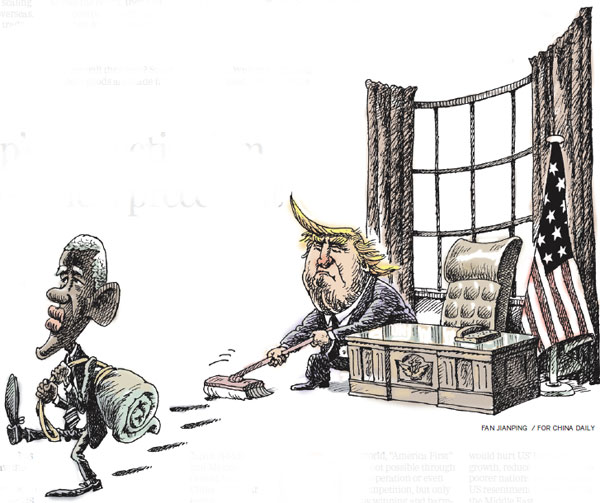
After his inauguration, US President Donald Trump has begun to reset the White House trade policies. But the consequences of his "America First" stance could be disastrous.
After his inauguration on Friday, Trump announced the United States will withdraw from the Trans-Pacific Partnership agreement and declared the North Atlantic Free Trade Agreement will be renegotiated. If Mexico and Canada refuse to renegotiate the trade deal, he has threatened to withdraw the US from NAFTA.
Trump has also promised to renegotiate or reject other US international commitments. And he has threatened to impose 35-45 percent tariffs on imports.
His appointments also suggest potential trade friction. He has selected Peter Navarro, the author of several sensationalist China-bashing books, to head the new National Trade Council, which will oversee the US' industrial policy. Navarro's anti-China buddy Dan DiMicco, former CEO of the largest US steel company Nucor and a vocal free trade critic, is Trump's trade advisor and former Reagan administration trade hawk Robert Lighthizer is his pick for US Trade Representative.
The three will work with US Secretary of Commerce, billionaire Wilbur Ross, who made a fortune by offshoring American jobs.
Targeting the US deficit, Trump has named Japan as one of the deficit contributors, which Japan's Finance Minister Taro Aso considered inappropriate. In terms of trade imbalances, "China is No 1," Aso said.
But in protectionist initiatives, blame is in the eye of the beholder as one country's deficit is another's surplus. Trump's trade warriors will begin by singling out nations that have a large trade surplus with the US. That makes big trading economies obvious targets. In 2015, the list was topped by China ($367 billion), Japan ($69 billion), Mexico ($61 billion) and Germany ($60 billion)
However, they are likely to ignore the size of these surpluses on a per capita basis. If we take into account population size, Germany ($720) is the deficit leader followed by Japan ($543) and Mexico ($488), with China ($262) far behind.
And if the Trump administration really is serious about targeting the deficit leaders, it should probably consider a trade war with Ireland. After all, the US has a deficit of $30 billion with Ireland, which translates to $6,380 in per capita terms - that's nine times that of Germany and 24 times the Chinese figure.
In reality, trade deficits are likely to serve as pretexts for protectionism - even if such policies penalize the rest of the world.
Trump's goals may well be dictated by realpolitik. Deficit criticism serves largely as an effort to undermine European unity (hence his anti-Merkel tirade), the rise of China and Mexico, and Japanese reforms. In such a win-lose world, "America First" is not possible through cooperation or even competition, but only by winning and harming perceived adversaries.
And yet, historically, US trade deficits did not start with China, or any other single country. Rather, they are regional and have prevailed for more than 41 years with Asia - first with Japan, then with newly-industrialized Asian tigers and recently with China and emerging Asia.
A single-minded focus on trade deficits ignores the fact that global economic cooperation is not just about trade in goods, but about trade in services and high-technology. It also includes investment, which Trump would like to attract from the very same countries that he risks alienating with his trade policy. And it includes migration flows, which Trump would like to restrict dramatically, which would hurt US' long-term growth, reduce remittances to poorer nations and boost anti-US resentment particularly in the Middle East.
Trump's stated protectionism does have a historical precedent. In 1930, the US Congress passed the notorious Smoot-Hawley Tariff Act, which sharply raised the cost of foreign imports. While it seemed to work initially, it soon caused other nations to retaliate. Rounds of tit-for-tat retaliation contributed to the Great Depression, and the way was paved for another world war.
Trumping world trade is a bad idea, but its timing is even worse.
The author is the founder of the Difference Group and he has served as the research director at the India, China, and America Institute (USA) and a visiting fellow at the Shanghai Institutes for International Studies (China) and the EU Center (Singapore).




Copyright 1995 - . All rights reserved. The content (including but not limited to text, photo, multimedia information, etc) published in this site belongs to China Daily Information Co (CDIC). Without written authorization from CDIC, such content shall not be republished or used in any form. Note: Browsers with 1024*768 or higher resolution are suggested for this site.
License for publishing multimedia online 0108263 Registration Number: 130349