Nobel-winning economist Robert Engle suggests improvement in capital allocation for fast-growing SMEs in China, Liu Xiangrui reports.
American economist Robert Engle gave Chinese officials some ideas on how to make China's financial sector more efficient.
Engle, winner of the 2003 Nobel Prize in economics along with British economist Clive Granger, was invited to Beijing last week by the State Administration of Foreign Experts Affairs to give his suggestions on risk management in China's capital market, because of his expertise in studying volatility.
Financial institutions should be subjected to regular stress tests to see if they remain solvent enough in the face of an economic downturn. The results of such tests should be published publicly and become benchmarks for performance of banks as well so that they do a more effective job of choosing where the loans go, he says.
"I think that many more benefits will come from improving allocation of capital to the fast-growing SMEs, which are also job creators," says Engle, 75.
He and Granger are recognized for developing a path-breaking statistical model called the autoregressive conditional heteroskedasticity that is designed to analyze unpredictable movements in market prices and interest rates. The method can also measure systematic risks in financial markets, especially on a short-term basis.
"If you try to predict a year in the future, it's very complicated. If it's a day in the future, that's not so hard," he explains. "If we talk about risk management for financial applications, maybe short-horizon predictions are enough."
Engle earned a master's degree in physics before he went on to acquire a PhD in economics from Cornell University in 1969.
"I decided that I wanted to work on something that more than 10 people in the world will understand," he says of the reason behind changing streams in academics.
While studying economics was at first a "slow and painful process", Engle believes his background in physics and statistics eventually helped him stand out as an economist.
"Because in physics we do experiments to measure some complicated things and figure out what they really mean. That's the same way we do economic analysis," he says.
A longtime professor of economics, Engle now teaches at New York University's Stern School of Business, where he is the Michael Armellino professor of financial services management.
Engle paid his first visit to China in 1985, when he was invited to teach an econometrics course at Renmin University in Beijing. During the six-week program, which was sponsored by the Ford Foundation and China's Ministry of Education, Engle and two other American teachers taught students from different parts of the country.
Chinese students were rather quiet back then, and he did all sorts of things, including giving them small souvenirs, to get them to talk.
As part of the trip, Engle toured Shanghai, Guilin and Chengdu and visited many tourist sites in the cities.
"China has changed so dramatically in 30 years. That's extraordinary."
People in Beijing were still wearing old-style blue outfits, and there were very few cars and everybody was riding a bicycle in the 1980s. It was also hard to find people who spoke English, and he had to get somebody to write down in Chinese the name of his hotel so that he could tell a taxi driver to take him back, Engle says.
"If they (Chinese authorities) can figure out what's the right thing to do, they'll do it. And they've been very good at that," he adds.
Engle, who is on an advisory board of the Chinese Academy of Social Sciences, comes to China more often these days, attending conferences and giving talks.
In 2014, Engle launched a branch of the Volatility Institute of the Stern School of Business, in Shanghai as part of a New York University initiative there. He is director of the institute.
NYU Shanghai, which was jointly established by New York University and East China Normal University, is the first Sino-US university campus.
Operated in close partnership with the Stern School and applying tools such as an award-winning model to analyze data, the Volatility Institute at NYU Shanghai provides financial information and analysis of the markets on its website for economists, regulators and even the general public.
The Shanghai institute has cooperated with the stock exchange and universities in the southern metropolis, and has also started an annual conference series that brings experts to discuss China's financial system, Engle says.
Despite his busy schedule as a high-profile economist and a regular teaching schedule, Engle tries to stick to hobbies like figure skating and dancing.
But whenever he gets a chance to relax, he finds a lot of questions running through his mind.
"I always look for simple answers," says Engle, who rewards himself with simple pleasures like a cup of coffee every time he figures out an answer.
Contact the writer at liuxiangrui@chinadaily.com.cn
|
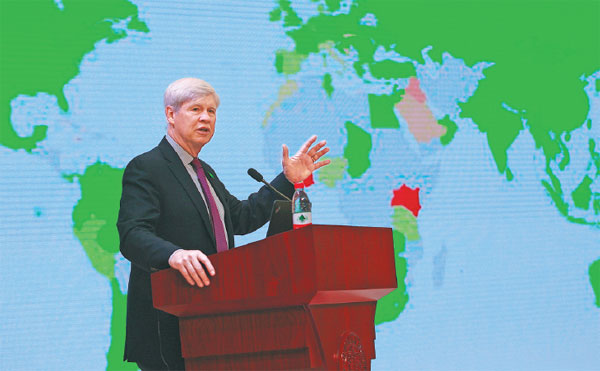
Robert Engle, a Nobel laureate, makes a speech at an economic forum in Nankai University in Tianjin in October 2016. Photos Provided To China Daily |




Copyright 1995 - . All rights reserved. The content (including but not limited to text, photo, multimedia information, etc) published in this site belongs to China Daily Information Co (CDIC). Without written authorization from CDIC, such content shall not be republished or used in any form. Note: Browsers with 1024*768 or higher resolution are suggested for this site.
License for publishing multimedia online 0108263 Registration Number: 130349