Beasts portrayed in movies may be scary - but audiences complain they're not really Chinese
After watching Zhang Yimou's latest film The Great Wall , Gu Meng was impressed by the army of Tao Tie monsters from Chinese mythology. However, he complained that the Tao Tie in Zhang's film were not "Chinese" monsters.
"They look like Western ones with Chinese names. They have more in common with monsters from Hollywood films, such as Godzilla," says Gu, a programmer in Beijing who loves monster movies.
Gu is not the only one to feel this way. Many Chinese netizens say that as the Tao Tie is seen as one of the four evil creatures - and is believed to be the offspring of a dragon, according Chinese mythology - it should have been portrayed as a single beast, instead of hoards of ant-like beasts in the film.
|
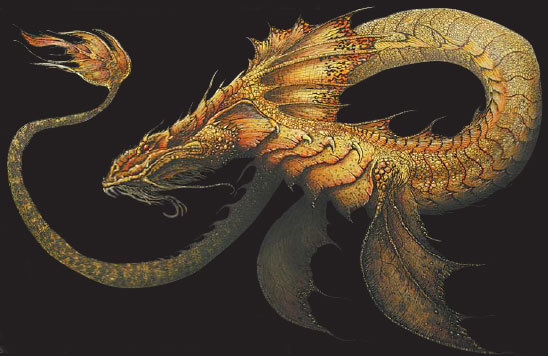
A dragon designed by Gino Acevedo with wings and a body inspired by sea horses. |
But the complaints are not only about Tao Tie.
Chinese people have long complained that monsters portrayed in domestic movies look like those in Western films. That's not surprising, since many were created by Western companies.
The Tao Tie in Zhang's film, which is based on the Chinese literary work Classic of Mountains and Seas, has been created by the New Zealand company Weta Workshop.
Gao Xia, a concept designer with Weta Workshop, who worked on rendering Tao Tie, says: "Chinese monsters are very different from their Western counterparts. It is also more difficult to portray Chinese monsters on screen because of the cultural factor."
Pointing out some of the challenges involved in creating Chinese monsters, he says that, for example, the eyes of Tao Tie must be under the arms according to mythology. However, in the film they are moved to the neck.
Referring to Hollywood creatures, he says: "They must be anatomically perfect. The veins of the monster, the color of its skin, the muscles and even the parasites in them must make sense."
Another problem with creating Chinese versions, he says, is that ancient paintings that portray Chinese monsters often use clouds and fire, and many monsters from folk tales and mythology only exist in the written form, making them difficult to portray.
"Just like Chinese ink paintings, we put more stress on imagination," says Gao.
Speaking about the difference between monsters from the East and West, Gino Acevedo, who has been involved in the creation of monsters for films like The Lord of The Rings, The Hobbit and Alien, says Eastern culture is fond of the powers of supernatural beings, while the West turns to nature for inspiration.
Acevedo himself is a good example of a monster expert inspired by nature.
His favorite TV shows were all about animals. He loves lizards and snakes so much that he once raised more than 30 kinds of snakes and lizards in his bedroom.
The dragons he now designs are based on these reptiles.
His monsters often have sharp teeth or long tusks, which he says are inspired by crocodiles.
"I think ghosts and monsters from the East are more scary. They are supernatural. And, sometimes, even though they do not have eyes, they still know where you are."
When it comes to the creatures that he finds memorable, he says that the ghosts and monsters from A Chinese Ghost Story, produced by Hong Kong director Tsui Hark, impressed many Westerners.
The film is about a love story between a young man and a female ghost.
Referring to the size of the monsters, Acevedo says that those in the East have the same proportions as human beings, but monsters in Western films typically have bigger bodies to show that they are not humans.
Acevedo says that, although the West has a long history creating monsters on screen, China can find ideas from its own rich mythology.
Gao says that after working with Western companies he feels it is now time for him and his Chinese peers in the film industry to look more closely at Chinese culture.
He says this is because if you want to create a monster to meet local tastes you need cultural context.
This view is supported by Yan Dingxian, 80, creator of the Monkey King and monsters in the animated film Havoc in Heaven, which was made in the 1960s.
He says that it is a deep understanding of Chinese cultural elements like Peking Opera, mythologies and martial arts that made the movie popular with Chinese audiences at the time.
dengzhangyu@chinadaily.com.cn




Copyright 1995 - . All rights reserved. The content (including but not limited to text, photo, multimedia information, etc) published in this site belongs to China Daily Information Co (CDIC). Without written authorization from CDIC, such content shall not be republished or used in any form. Note: Browsers with 1024*768 or higher resolution are suggested for this site.
License for publishing multimedia online 0108263 Registration Number: 130349