More Chinese children join 'camp education', where learning occurs alongside playing
Zhao Qing fondly reflects on her summer camp at UWC (United World College) Changshu, in south China. She cherishes "the sense of belonging and sense of being herself" she gained at the two-week camp.
With more than 130 other teenagers from 14 countries, Zhao, 15, took part in outdoor adventure activities and workshops at the camp and became firm friends with an American girl who shared her interest in philosophy.
While Zhao's camp experience would be common in some Western countries, it is much less so for a Chinese teenager.
|
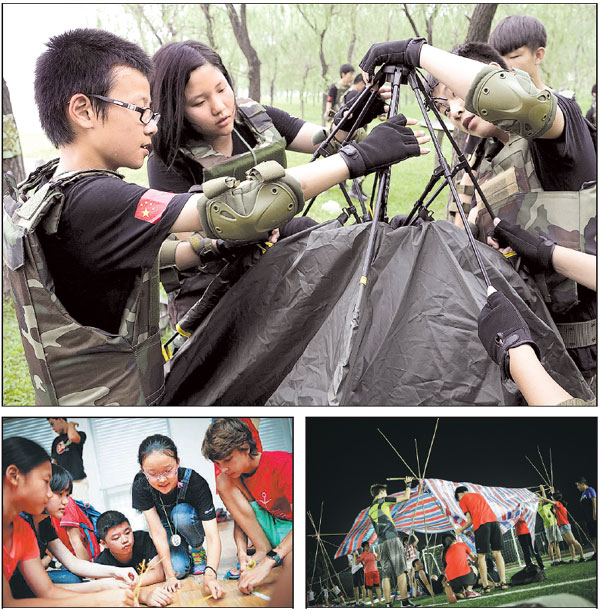
Clockwise from top: Students participate in a military summer camp in Beijing. Li Xin / Xinhua; campers attend the Refugee Camp Challenge in the summer camp at United World College Changshu; Zhao Qing (center) cooperates with other campers. Photos Provided by Ideas |
Her camp was organized by Initiate Development for Education and Service (IDEAS), a pioneer of China's camp industry. Zhao Wei, president of the China Camp Education Alliance and founder of IDEAS, says recognition of the education potential of camps has surged among Chinese parents and educators in recent years.
"In China, we prefer to use 'camp education' because camp is not just about play - it is education through play," says Zhao Wei. "Unlike travel or study tours, camps actually create a community for experiential learning with well-arranged activities. It is a powerful vehicle to teach young people 21st-Century skills and dispositions, including leadership, communication, collaboration, critical thinking, and creativity."
Zhao Qing attends the Affiliated High School of Peking University. She says the attraction of camp lies in the activities that require teamwork and developing a sense of achievement from effective collaboration in solving practical problems.
In the Refugee Camp Challenge, her group played refugees and the camp mentors played officials from the government and social institutions. The mentors gave them bamboo poles, woven bags, rope, tape and other tools. The group had to design a large tent to accommodate them all for a night.
It brought home the hardships facing real refugees and she improved her understanding of "leadership".
"In school and daily life, teachers and parents also emphasize leadership, but they usually focus on whether you are elected a class monitor or course representative," says Zhao. "I liked the free environment where we had no designated leaders, but we helped each other to make the most of ourselves. I think real leadership means helping others to be better people - not necessarily someone with a title."
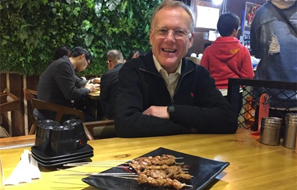
John Jorgenson, president of the International Camping Fellowship, says there is a consensus among educators internationally on the limitations of formal education and the values of nonformal education.
Jorgenson has been to many Chinese schools and talked with many Chinese parents. He notices that educators and parents are seeing deficits in noncognitive skills of their young people and are looking for tools to help create more well-rounded learners.
"I found that in China, there is a growing interest in what the children are doing outside the school. Camping has caught the attention of Chinese educators because it offers powerful lessons in teaching the soft skills needed to flourish in the future," Jorgenson says.
With the increased recognition of camp education, the Chinese government and some social organizations have built a range of camps across the country.
The Beijing International Youth Camp, initiated by the Beijing Municipal Youth League Committee, has created about 10 sites in Miyun, Changping and Haidian districts over three years, providing new experiences for primary and secondary school students in Beijing.
Lu Yongli, principal of Beijing No 2 Experimental Primary School, has studied camp education. In her opinion, good education should be a mix of family, school and social education. As a model of social education, camps are a perfect supplement to school and family.
"Camp education gives children a miniature version of a real society in which the child is self-managing and self-supporting. They have to schedule their time, resolve conflicts and face frustration without their parents' help," Lu says.
Scott Brody, a board member of the American Camp Association, operates Camps Kenwood and Evergreen in the U.S. state of New Hampshire. In recent years, they have received more Chinese children, whose parents want them to have a cross-cultural camp experience.
"I believe that Chinese youth have high demand for high quality camp activities," says Brody. "I have met many enthusiastic Chinese camp professionals who are willing to borrow expertise and personnel from all around the world to help improve China's camp education."
Zhao Qing's mother, Dr. Gao Bo is delighted at her daughter's personal development during her two weeks at camp.
"She is more confident in challenging herself and expressing herself, and she shows a stronger sense of responsibility," says Gao.
China Features




Copyright 1995 - . All rights reserved. The content (including but not limited to text, photo, multimedia information, etc) published in this site belongs to China Daily Information Co (CDIC). Without written authorization from CDIC, such content shall not be republished or used in any form. Note: Browsers with 1024*768 or higher resolution are suggested for this site.
License for publishing multimedia online 0108263 Registration Number: 130349