The world's oldest mummies have just had an unusual checkup.
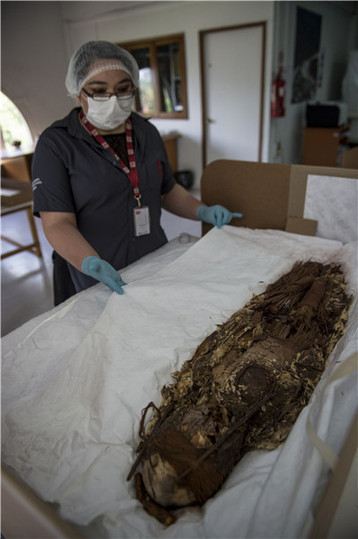
More than 7,000 years after they were embalmed by the Chinchorro people, an ancient civilization in modern-day Chile and Peru, 15 mummies were taken to a Santiago clinic recently to undergo DNA analysis and computerized tomography scans.
The Chinchorro were a hunting and fishing people, who lived from 10,000 to 3,400 BC on the Pacific coast of South America, at the edge of the Atacama desert.
They were among the first people in the world to mummify their dead. Their mummies date back some 7,400 years - at least 2,000 years older than Egypt's.
Now, researchers are hoping to use modern medical technology to reconstruct what they looked like in life, decode their genes and better understand the mysteries of this ancient civilization.
The 15 Chinchorro mummies, mostly children and unborn babies, were put through a CT scanner at the Los Condes clinic in the Chilean capital.
|
Chilean anthropologist Veronica Silva shows one of the mummies from the ancient Chinchorro culture.AFP |
"We collected thousands of images with a precision of less than one millimeter," says chief radiologist Marcelo Galvez.
"The next phase is to try to dissect these bodies virtually, without touching them, which will help us preserve them for another 500,000 years."
Using high-tech computer processing, researchers are busy reconstructing the mummies' muscles and facial features.
The Chinchorro, who apparently had a complex understanding of human anatomy, would carefully remove the skin and muscles of the deceased.
Using wood, plants and clay, they reconstructed the body around the remaining skeleton, then sewed the original skin back on, adding a mouth, eyes and hair.
A mask was then placed over the face.
The result looks like something in between a statue and a person - eerily lifelike even after thousands of years.
Surprises have already begun to emerge from the CT scanner.
The smallest mummy, it turns out, was not a mummy at all.
"There was no bone structure inside. It was just a figurine, possibly a representation of an individual who could not be mummified," says Veronica Silva, the head of the anthropology department at Chile's National Museum of Natural History.
Researchers also took skin and hair samples from the mummies to analyze their DNA, in hopes of identifying genetic links with the modern-day population.
"We want to better understand their way of life - from their diet to whether we Chileans still carry their genes," says Silva.




Copyright 1995 - . All rights reserved. The content (including but not limited to text, photo, multimedia information, etc) published in this site belongs to China Daily Information Co (CDIC). Without written authorization from CDIC, such content shall not be republished or used in any form. Note: Browsers with 1024*768 or higher resolution are suggested for this site.
License for publishing multimedia online 0108263 Registration Number: 130349