Orchestral piece evokes harmony
By Li Xiang in Paris ( China Daily )
Updated: 2013-09-27
Enthusiastic reception in Paris for performance of Confucian-themed work
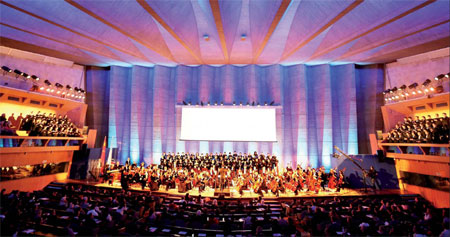
The symphony on the theme of Confucianism performed by the Shenzhen Symphony Orchestra in Paris has received a warm response from French and Chinese people alike. More than 1,300 people attended the performance at UNESCO headquarters on September 21, and many of them said that it offered them an opportunity to gain a deeper understanding of Chinese culture.
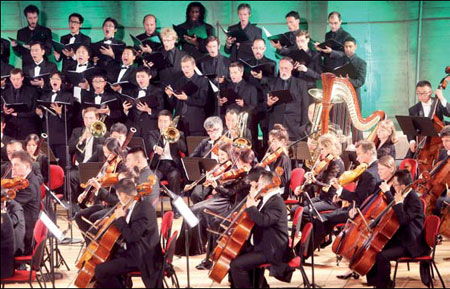
The 70-minute symphony, known as Ode to Humanism, is inspired by the core values of Confucian philosophy, which can be summed up as benevolence, justice, courtesy, wisdom and faith (ren, yi, li, zhi and xin). It consists of a prelude, five movements and a coda.
Ode to Humanism was composed by Chinese contemporary composer Wang Ning. Conducted by Zhang Guoyong of the Shanghai Conservatory Orchestra, 80 players and 134 choristers interpreted the fundamental values of Confucian philosophy with the poetic lyrics written by Yi Heng and Han Wangxi.
"Whenever I hear the melody, I always get excited and have strong emotions," said conductor Zhang Guoyong at a media briefing.
"There are 36 French professional singers in our choir. And I can tell from their eyes that they love the Chinese music very much. It is meaningful for us that Chinese music has been accepted and recognized by them."
Zhang said the symphony is a "wonderful combination of Chinese culture and Western art" with the ultimate aim of inspiring people to think about the future of mankind in a world of conflict.
"The most important messages it tried to deliver is harmony with diversity," Zhang said.
Wang Jingsheng, head of the CPC Shenzhen committee publicity department, first proposed the idea of having a symphony composed in 2006 to better introduce Confucian philosophy and Chinese civilization to the world.
It took more than six years for Chinese musicians and artists to complete Ode to Humanism. Experts in Confucianism met three times in Shenzhen to decide on what the symphony should present. After two public performances, seminars were organized for musicians and scholars to offer suggestions. The participants responded enthusiastically and spoke highly of the work.
The first movement of the symphony, Benevolence, uses harmony to express continuous change. The second movement, Righteousness, uses cellos to express the idea of a righteous person who fights evil, and the third movement, Propriety, is said to be the most refined.
And the fourth movement, Wisdom, uses a traditional singing style called yin song to help create a magical atmosphere. The last movement, Faithfulness, features brass and percussion, and leads to the final part, Wen Ming Yao.
The UNESCO performance was the Shenzhen Symphony Orchestra's international debut. It performed the symphony more than 10 times in Shenzhen to prepare for the Paris concert.
"The performance successfully expressed the Chinese people's hope for peace and showed that China is willing to take part in building a new value system in the world and to contribute more," said Han Wangxi, director of the publicity office of Shenzhen government.
"The symphony perfectly combines Chinese culture and Western symphonic music and creatively expressed the core values of China's Confucian philosophy."
Different cultures should be integrated just as the oceans are interconnected, Han said. The symphony also offered Chinese people a chance to take a new look at their own traditions and culture, he said.
"The event in Paris had special meaning as it made us realize that we must be able to adopt a meaningful approach to integrate Chinese and Western culture and to find a better way to tell the Chinese story," he said.
The performance of Ode to Humanism coincided with the vision of Irina Bokova, director-general of UNESCO, for a new part of the organization's program to commemorate International Day of Peace on September 21.
"The event marked an important step that any nation could take to support the agenda of UNESCO to celebrate humanism," said Mehri Madarshahi, president of the Melody for Dialogue among Civilizations Association, which organized the performance under the patronage of the Chinese National Commission for UNESCO.
"Given the cultural treasure, Shenzhen should really be recognized as one of the most advanced and modern cities in China," she said. "Shenzhen has done an important job that shows we can communicate through true music, and it can encourage politicians and decision-makers around the world to start thinking about the agenda of new humanism in the 21st century."
Lin Jing contributed to the story.
lixiang@chinadaily.com.cn
|
Top: More than 1,300 people attended the performance of the Shenzhen Symphony Orchestra in Paris on Sept 21. Above: The symphony, known as Ode to Humanism, is inspired by the core values of Confucian philosophy - benevolence, justice, courtesy, wisdom and faith. Photos Provided to China Daily |
(China Daily Africa Weekly 09/27/2013 page26)