Financial restrictions limit growth of private cultural companies
By Wang Hongyi in Shanghai ( China Daily )
Updated: 2013-07-31
|
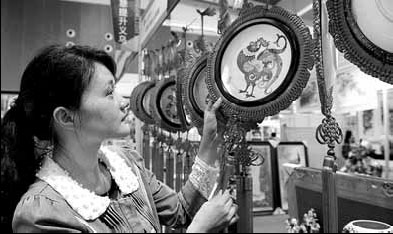
The China Yiwu Cultural Products Trade Fair, which held its eighth annual event in April, aims to provide a trading platform for domestic cultural enterprises. Zhang Jiancheng / for China Daily |
Restrictions on private investment in the cultural sector have limited the growth of private enterprises, according to a report released on Tuesday.
The report, authored jointly by Shanghai Jiao Tong University's National Innovation and Development Base and the China Culture Index Research Center, found State-owned cultural companies remain the primary force in the industry.
"In terms of investment structure, State-invested companies have dominated the cultural industry. The government has implemented strict limitations for market access," said professor Hu Huilin, director of Shanghai Jiao Tong University's National Innovation and Development Base, who led the research.
The report noted financing channels are limited for private companies, causing a lack of financial momentum to seek better development.
According to research by the Ministry of Culture in 2010 on the country's 300 private culture companies, 56.7 percent said they have difficulties raising money.
Their financing methods were limited, and more than 80 percent of companies relied on their existing funds.
Currently, the entry threshold in performing arts, advertising and entertainment industries is relatively low, offering ample room for private enterprises, while in the publishing, audio-video, media and television-film sectors, private capital faces more limitations.
"There were only three cultural enterprises in the top 500 Chinese private companies in 2009 and they were in the paper, printing and stationery business," Hu said. "They are enterprises manufacturing cultural products but don't have much cultural connotation."
The China Cultural Industry Development Index, intended as an indicator of the performance of the country's cultural sector, was part of the report.
Beijing gained the top slot with a score of 82.75, followed by Guangdong province at 48.52 and Zhejiang province at 47.5. Others listed were Jiangsu, Shandong, Shanghai, Tianjin, Hunan, Fujian and Liaoning.
Many factors were included in the evaluation criteria, such as cultural market development and cultural innovation. The research team picked the top 10 cities and provinces that had excelled in the development of cultural industries.
"Besides policy support, Beijing has long enjoyed the advantage of being the country's cultural center, which provides a foundation for developing the cultural industry," said Jin Yuanpu, a professor at Renmin University of China.
Researchers also said development of the cultural industry has a connection with economic growth, as the majority of the top 10 cities and provinces were concentrated in the Yangtze River Delta and Pearl River Delta areas.
In recent years, China has stepped up its efforts to develop its cultural sector. Last year, the Ministry of Culture released a cultural development plan that specifies guiding principles, strategies, goals and policy support for the cultural industry from 2011 to 2015.
The cultural industry is expected to see annual growth of more than 20 percent until 2015, according to the ministry.
wanghongyi@chinadaily.com.cn
(China Daily USA 07/31/2013 page5)