Wu Kingdom Capital in Ezhou
( chinadaily.com.cn, ezhou.gov.cn )
Updated: 2012-02-07
 |
|
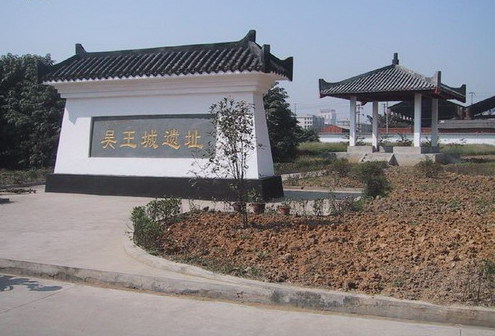
The Wu Kingdom Capital site was the capital city of the Kingdom of Wu during the Three Kingdoms period. |
The site has high archaeological and historical significance.
Archaeological findings show that the Wu Kingdom Capital is China’s only site containing the relics of capitals from the Three Kingdoms. The site has high archaeological and historical significance.
The Wu Kingdom Capital site was the capital city of the Kingdom of Wu during the Three Kingdoms period. In AD 221, Sun Quan went to Hubei province from Gong’an. Soon afterwards, he accepted the title of King of Wu, conferred by Cao Pi, Emperor Wendi of the Wei Dynasty. In August that year, he started to construct the capital city of Wu Kingdom. Sun Quan renamed Exian county as Wuchang in the hope of “flourishing by force of arms.”
In lunar April of AD 229, Sun Quan proclaimed himself Emperor of Wuchang, also known as the great capital city of Emperor Wu. In September, Sun Quan moved the capital to Jianye (today’s Nanjing in Jiangsu province). He assigned senior general Lu Xun to assist Prince Sun Deng to guard Wuchang. Wuchang became the second capital city of the Kingdom of Wu. In April of the Taiyuan reign, Sun Quan died. Zhuge Ke, a cabinet minister, rose to power. Zhuge had Wuchang Palace reconstructed and prepared to move the capital back to Wuchang. After a few incidents, the plan was aborted. In September AD 265, Sun Hao, the last emperor of Kingdom Wu, shifted to Wuchang. He left Ding Gu, an official censor, and Zhuge Jing, a senior general, to guard Jianye. Wuchang once again turned into the capital city of Kingdom Wu, with Jianye as the second capital. During the rule of Kingdom Wu, which lasted for 50 years, the Suns reconstructed the Wuchang Palace three times, and set Wuchang as capital twice. Wuchang’s history spans 1,700 years.
Wu Kingdom Capital site is found in Baizifan (today’s northern section of Gucheng Road). It faces Yangtze River in the north and Nanhu Lake in the south. It leans on Hutou Hill in the east (the curent heavy machine plant) and reaches Haokou in the west (today’s Xiongjia Lane, Xinmin Street). The capital city, a rectangular shape, covers 1,000 meters in the east-west direction and 500 meters in the north-south direction. It is three kilometers long in perimeter. The southern city wall is 60 meters long, 10 meters wide, and 4 meters high. The city wall is protected by a moat. The existing section is referred to as Haotang.
Yuanhe County Records wrote that the capital city of Sun Quan was constructed by Guan Ying, a general of Han Dynasty. The Taiping Description of the World said that the city had five gates, named after their directions, i.e. East Gate, West Gate, South Gate and North Gate. The fifth gate, Liujin, was set at the northwest corner. The Liujin Gate was connected to the riverside beach, a private garden of the king. To the east of the palace is Jiming Que, a giant architecture. The high platform was constructed to accommodate a tower where officials recorded performances and looked into the distance. The two towers, the Que, were constructed in traditional style, with a gap between them. Legend says that when the palace was completed, King of Wu hoped that the Que could be finished too. Ghosts and deities showed up to help during the night, allowing the Que to be constructed in one night. The work was completed when cocks crowed at dawn. Chen Zi’ang, a Tang poet, said in a poem that “Ghosts have not finished work yet, how could men save human power,” in reference to the legend. The story remains popular in Erzhou.
Wu Kingdom Capital site contains the Wuchang Palace, which is surrounded by palace walls. The palace comprises of the Taichi Hall, Guest Hall, and Peace and Happiness Hall. The Taichi Hall was the main hall for Sun Quan to meet cabinet ministers as emperor. The Guest Hall was used to hold sacrificial rites and receive guests. Peace and Happiness Hall was the residence of Sun Quan. In 1984, Wu Kingdom Capital was listed as a cultural relic for municipal protection. In 1992, it was elevated as a cultural relic for provincial protection.