 |
|
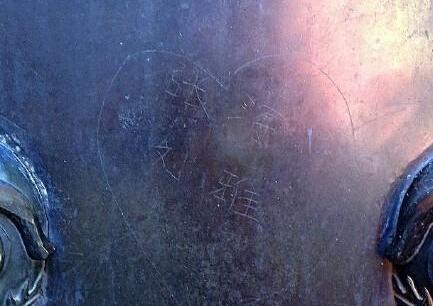
A couple carved their names on a 300-year-old vat at the Palace Museum, stirring widespread discussion online. [File photo]
|
A couple's scandalous behavior of carving their names on a 300-year-old vat at the Palace Museum has incited heated discussion online, most of which are accusations that inscribing on ancient relics is uncivilized behavior.
However, carving one's names on cultural relics to mark one's visit is not peculiar to modern Chinese. People at all times and all over the world have done it.
"Scrawling" can be traced back to ancient China
 |
|
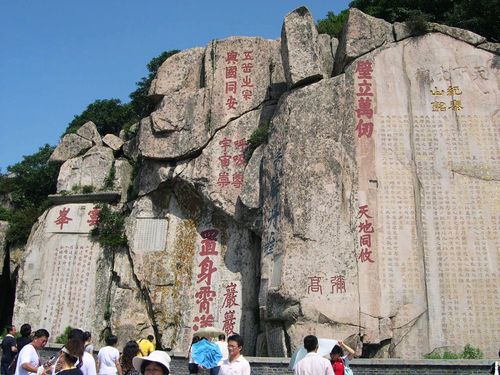
Inscriptions on precipices at Taishan Mountain. [File photo]
|
In China, the word "scrawl" originated from a verse by ancient poet Lu Tong, who said, "Suddenly, the ink splashes on my desk, then I smear my book like a crow" in his poem. Scrawls usually take on two forms, poems inscribed on walls and inscriptions on precipices. The former was popular among ancient scholars while the latter was a huge project that couldn't be completed by one person.
Wall poetry appeared as early as the Han Dynasty. According to historical records, there was a noted calligrapher Shi Yigong during the reign of Emperor Ling of the Han Dynasty, who liked writing on walls. His calligraphy on walls was greatly appreciated. So when he had no money to pay for a meal, he would write on the walls of the restaurant and beg for money from other customers. When he got enough money to pay for his meal, he would then wipe out his calligraphy.
There are also many cliff inscriptions on mountains which were left from ancient times. For example, there is a stone inscription from Tang Dynasty prime minister Li Shen, who was also a famous poet, written on a rock in Putian of Fujian province indicating his arrival there after he was demoted.