Restoration set to start on Confucius complex
Work has begun on a 320 million yuan ($50 million), five-year project to repair colorful paintings on the ancient buildings that comprise the Confucius temple, mansion and cemetery in East China's Shandong province, a cultural heritage official said on Friday.
Xie Zhixiu, head of the Shandong Provincial Administration of Cultural Heritage, said the project was the first of its kind for more than 100 years, since similar work was carried out late in the Qing Dynasty (1644-1911).
"After suffering from weathering for more than 100 years, these paintings are experiencing problems that include serious fading, cracking and detachment, making the repair work urgent," Xie said.
Collectively known as San Kong, the three Confucian sites in Qufu, where Confucius was born, are ranked alongside the Forbidden City in Beijing and the Summer Resort in Chengde, Hebei province, as the most famous ancient architectural complexes in China. They were listed as a UNESCO World Heritage Site in 1994.
Established in 478 BC, several emperors subsequently renovated and enlarged the Confucius Temple in Qufu over the years. As the largest and oldest Confucius temple, the complex at Qufu has served as a model for more than 3,000 Confucius temples that have since been built around the world.
Every year, more than 1 million people visit the site, and grand ceremonies to honor Confucius attract thousands of followers.
More than 200 craftsmen and about 30 technicians will carry out the painstaking repairs to the 140,000 square meters of paintings on the ancient buildings during the restoration, which will be funded by the central government, said Xue Qianqian, deputy director of the project's management office.
"The project involves a series of processes, including design, experiments and evaluation made by experts," Xue said. "It takes great effort to collect traditional painting materials, such as emerald green and ultramarine blue materials."
To recapture the traditional look of the facade, pig blood will be used in producing the paint, Xue said.
"Color paintings at San Kong illustrate Confucian thoughts, so the repair work should enhance the paintings' role in reflecting the social status and cultural significance of the architecture," said Wang Zhongjie who has devoted more than 60 years to restoring color paintings on ancient Chinese architecture.
Color painting was used in ancient China to decorate buildings in a way that represented the social status of the royal families that used them. For example, only emperors could use dragon images and only empresses could use phoenix images.
Lu Shoulin, an expert at the State Administration of Cultural Heritage, said that, even though workers will employ traditional color painting skills, they will also use advanced technology to ensure efficient repair work.
 |
|
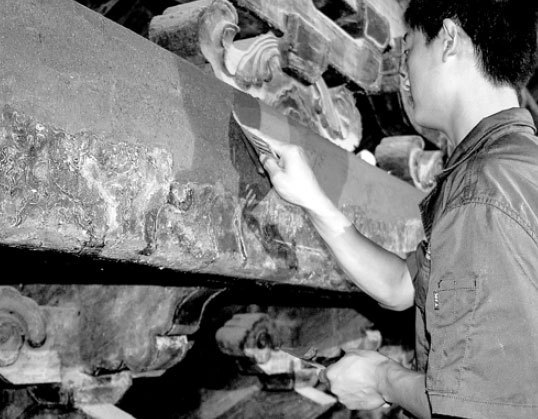
A craftsman prepares the surface ready for the restoration of paintings in July during experimental repair work of colorful designs on the ancient buildings of San Kong in Qufu, Shandong province. [Photo provided to chinadaily.com.cn] |
 Shandong: Where Excellence is made
 Building a Moderately Prosperous Society: The Tai'an Way
 Video: Jiunvfeng Park