Eating yuanxiao (sweet dumplings made with glutinous rice flour) is one of the special traditions of Lantern Festival. Lantern Festival is also called Yuanxiao Festival. Another name for yuanxiao is tangyuan, which literally means "boiled spheres."
Legend has it that yuanxiao date back to China's Spring and Autumn Periods. During the Tang Dynasty they were called mianjian (flour cocoons) or yuan bu luo ni. During the Song Dynasty they were called yuanzi (spheres) or tuanzi (dumplings).
There are many different types of yuanxiao, with fillings covering the entire range of the Five Flavors (savory, spicy, sweet, sour, and salty). Sweet fillings are the most common, and include sweet bean paste, sesame, date paste, ginkgo nut, peanut, almond, and hawthorn fruit. Other fillings include pickled cabbage, minced pork, minced ham, shrimp, green beans, and chrysanthemum. There are two methods for making yuanxiao - wrapping and rolling. Wrapped yuanxiao are called tangyuan, and are popular in southern China. Tangyuan are assembled by making a depression in a ball of glutinous rice flour dough, inserting the filling into the depression, and then sealing the ball. Rolled yuanxiao are popular in northern China. Assembly consists of rolling a small ball of the filling in dry glutinous rice flour, building it up like a snowball until it reaches the desired size. The completed yuanxaio and tangyuan may be boiled, steamed, or deep-fried.
With the approach of Lantern Festival, yuanxiao can be seen everywhere, further heightening the festive holiday spirit. The round shape of yuanxiao symbolizes the family circle, and eating yuanxiao symbolizes the hope for family reunions. Yuanxiao are not only a traditional holiday food, but also were used to express respect for the deities. Their round shape also represents perfection and unity. According to a Taiwan folk saying, "eating tangyuan leads to reunions."
Eating yuanxiao at home is only one part of Lantern Festival. Even more important is the tradition of attending temple fairs or street fairs and viewing lantern displays.
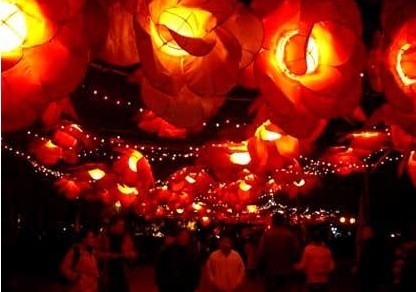
Many Chinese holidays involve lanterns. But Lantern Festival represents the epitome of this custom. Lanterns are first brought out on the thirteenth day of the first lunar month. They are tested on the fourteenth, formally lit on the fifteenth, and taken down on the eighteenth. The origins of Chinese lanterns reach back to the Stone Age. The coming of the Bronze Age saw the development of various kinds of worked metal lanterns, of which palace lanterns were the most ornate. Later, decorative lanterns came to be used in festivals. Various lantern festivals became quite popular during the Sui Dynasty, and during the Southern Song Dynasty, the custom of writing riddles on lanterns emerged. During this time, a festival in Qinhuaihe in Nanjing featured over 10,000 lanterns. During the Qing Dynasty, magnificent exhibitions of lanterns were held in the capital city. Lantern contests were also held, with the dragon lantern being the most famous competitor. Beijing also had a famous lantern market, while southern China was known for shows of lanterns on rivers and lakes. Ningxiang County in Shanxi Province was known for its "Mountain Festival of Lights," during which the mountainside was covered with a festive display of 10,000 lanterns. These festivals not only provided a beautiful show of multicolored lanterns, but also featured a wide range of folk art and performances, such as the Lion Dance, Dragon Lantern Dance, stilt-walking, land-boat racing, and Yangge dancing.