 |
|
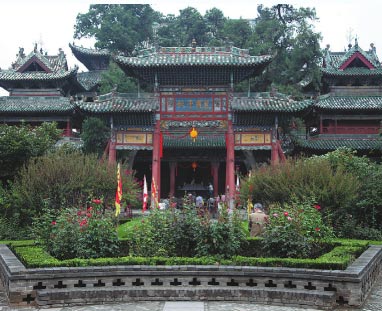
Guandi Temple in Xiezhou county is dedicated to General Guan Yu. [Photo by Reinhard Klette/China Daily] |
The largest waterfall on the Yellow River, and the second-largest in China, was impressive enough when seen from its edges, but the aerial views showed its full power. The drone also attracted its own admirers, with many Chinese stopping to photograph it in flight and on retrieval.
The city of Linfen, once known for the dubious honor of being one of the most polluted cities in the world, has shaken off that title as it looks to move from its traditional coal industry to focus on tourism. The Fen River runs through the downtown area, where we stayed, and our hosts took us on a spontaneous drive through Fen River Park and a short river cruise one evening. The river, which used to be full of garbage, has been rejuvenated and the park is filled with pleasant public areas. By night, the bridges and many of the buildings are illuminated, making for stunning photo opportunities.
The caliber of the photographers on the trip was superb, and I have been amazed as my WeChat account buzzes constantly to show me thumbprints of their shots as they edit and upload them.
In Linfen, a city that covers 20,275 square kilometers and has a population of almost 5 million people, we also visited the Taosi relics site that is believed to be the origin of China's civilization, dating back about 4,500 years to the time of Emperor Yao. Excavation began in the area in 1978 and more than 1,000 tombs have been discovered. The site also has the reconstruction of 13 pillars that, when you stand at a certain point to observe the sunrise, mark off the seasons of the Chinese year. It took two years of research for the archeologists and scientists to discover the purpose of the pillars and discover the remains of the central point.
The results of another archeological dig were a favorite of mine-four large iron oxen and their handlers that were smelted and cast during the Tang Dynasty (AD 618-907). The four are one of two groups used as mooring posts for the Pujin Bridge in Yongji-a major crossing point in ancient times. Each iron ox measures 1.9 meters high, 3 meters long and is 1.3 meters wide, and includes a three-meter pole set at an angle on the base to anchor the oxen more firmly as the river pulled on the floating bridge.