Northern China's First Ancient Castle
Updated: 2012-03-01
 Douzhuang Village -- "Little Beijing"
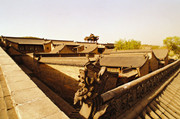
Reputed as "Little Beijing" and "the Lady City", Douzhuang village is one of the earliest castles in the Qinhe River Valley, constructed by Zhang Wudian, the minister of revenue of theMing Dynasty. It is an ancient castle with nine city gates and nine passes. Two years after its construction, when Douzhuang village was besieged by bandits, Zhang Wudian's daughter-in-law led the servants to defend the castle for three days, saving the village. The city therefore earned its name as "the Lady City" after Zhang's daughter-in-law. In the following years, Tuncheng city, Shangzhuang village, Huangcheng city, Guoyu town and Diyi city were constructed in succession to ward off attacking bandits.
 Warding off bandits
Shanxi Province occupies the mountainous region between China's central plains and the northern desert. Its transport routes provided the Han Chinese of the central plains with a means to communicate with desert tribes living beyond the border. Trade links, dating from the first century BC, flourished during the Sui and Tang dynasties (581-907) and strong family loyalties among Shanxi people, coupled with their diligence, thriftiness and teamwork, brought about a thriving merchant culture that endured for some 500 years until the late Ming Dynasty. Staying true to their roots, these merchants returned to their families with wealth to build grandiose mansions.
For thousands of years, migratory northwestern nomads invaded the central plains. As the main pass leading to the central plains (and a gathering place for merchants), the Qinhe River Valley became a focus for the nomads and roving bandits, especially in the final years of the Ming Dynasty. Guoyu village was robbed several times, leaving the homes damaged and the villagers heavily injured.
Zhong Shaoyi, expert from the Academy of Military Sciences tells us: "In the time of turmoil of the Ming and Qing dynasties, these typical and well-conserved castles were built to ward off roving bandits and protect the local villagers. Shanxi Province was a relatively rich prefecture at that time where many noble families and court officials established their family property. To protect their properties and safety as well as stability of the prefecture, such castles were constructed with collected money from both the local government and the masses."