Home> News
Japanese expert set to brighten up Shanghai's CBD
Updated: 2016-09-20
( China Daily )
Fram Kitagawa believes that fine art is not independent of ordinary people's lives. In 1994, the 70-year-old Japanese exhibition curator changed Tachikawa, an abandoned military area on the outskirts of Tokyo, into an experimental art zone.
That year, he brought the FARET Tachikawa project to the small town of seven blocks, attracting 92 artists from 36 countries and regions. The project saw more than 100 public art pieces blended into the urban landscape.
This example has been copied around the world.
Kitagawa, chairman of the Tokyo-based Art Front Gallery, tells China Daily: "I prefer to involve many artists to get different perspectives. They are not here to create a single monument, which emphasizes uniform values."
Now, he has a goal in China: To create the world's most important public art zone in Lujiazui, the heart of Shanghai's central business district.
Over the year 2017-18, 43 outdoor public-art pieces are to be created in a new business area in Lujiazui, which covers more than 250,000 square meters, says Kitagawa, who is the art director of the project.
Speaking about Shanghai, Kitagawa, who recently visited Beijing to deliver a lecture at Tsinghua University, says: "Since its opening up as an international harbor nearly 180 years ago, the city has always been a hub for different cultures due to cross-border communication and trade."
Kitagawa says that 15 spots have been reserved for "renowned" artists, while the rest are open for applicants.
The deadline for applications is the end of this month, but Kitagawa says he has already received proposals from artists from around 60 countries and regions.
"The project in Lujiazui has an international flavor and will use artists to create a public space, which has deep cultural connotations," he says.
"Public art is to let people experience different ways of life in one lifetime, just like reading."
Meanwhile, in spite of his global perspective, Kitagawa says he wants public artwork to be deeply rooted in local communities.
"It can be successful only when it is admired by local people and reflects their happiness and sadness."
As for Kitagawa's other projects, there is the Echigo-Tsumari Art Triennale in a mountainous area of Japan's Niiagata prefecture. Launched in 2000, the first show featured 148 artists from 32 countries and regions, showcasing the relationship between humans and nature through more than 1,000 pieces.
He says that local farmers are part of that "art gallery", which covers 760 square kilometers.
Speaking about the event's impact and the farmers' roles in it, he says: "Perhaps, they did not understand the works at first, but when the event brings visitors ... tourism brings happiness to local people. And Echigo-Trumari has seen an extraordinary number of repeat visitors."
Over half of the visitors to the event have been there before.
Another major project is the Setouchi Triennale, which Kitagawa launched in 2010.
The event was meant to revitalize the local economy by creating modern art pieces related to the local environment.
Giving his views on public participation in the creation of these art zones, Kitagawa says that, in the case of Lujiazui, representatives of the property owners are to be invited to have their say in the choice of the art to be displayed as a first step to blending their daily lives with the upcoming art zone.
But Kitagawa is against the idea of polls when it comes to designing public art spaces.
However, the Lujiazui project will have an appraisal panel comprising museum curators, art commentators and government experts.
"Different tastes can live together, and we don't need uniformity. The quality of the artwork is the priority," he says.
"I'd like to use my previous experience to bring something unprecedented to Shanghai, but no one knows what is about to come."
Kitagawa says he is more interested in ushering public art into traditional neighborhoods in Chinese cities, rather than newly established districts.
"And, with China now advocating a 'beautiful countryside', I think I can help bring new life to those villages."
But he admits it will take time before public art is widely accepted.
"In most cases, artists create works following their intuition. And though the works may not have high-sounding themes, they do manage to touch people's hearts and give them positive energy," he says.
Comparing art to a baby, he says: "It is disobedient and not productive, but very interesting. And people will build connections with each other to protect it."
|
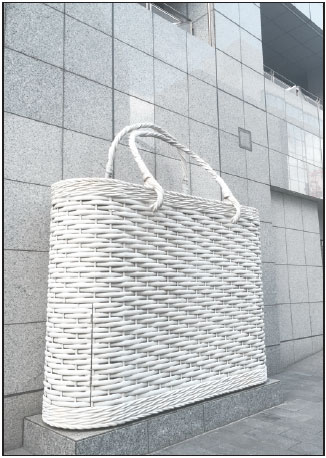
An installation at Tachikawa art zone on the outskirts of Tokyo.Photos Provided To China Daily |