Kang Youwei's path toward peace and tranquility ended in Qingdao
Having fully experienced the turmoil of the turbulent early 20th century, renowned reformer and political thinker Kang Youwei chose to withdraw to the coastal city of Qingdao in Shandong province, to live out the rest of his life in peace.
Kang was born in 1858 in Guangdong's Nanhai county - now the Nanhai district in Foshan city.
An ardent Chinese nationalist and internationalist, Kang was influenced by Western culture, especially the political sciences. Together with other young scholars, he proposed a reform based on the constitutional monarchy system to the central authorities of the Qing Dynasty (1644-1911) when he was taking an imperial test in Beijing 1895.
|
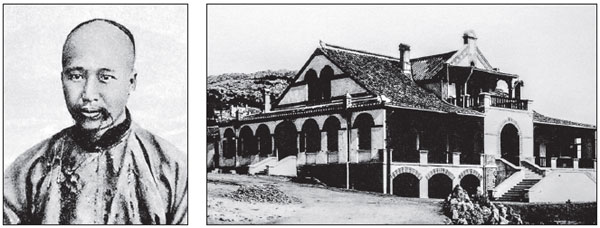
From left: Kang Youwei, the renowned reformer and political thinker in the late Qing Dynasty. Kang's residence at No 5 Fushan Branch Road, Qingdao. Photos Provided to China Daily |
His proposal was accepted by Emperor Guangxu in 1898 and a reform was implemented for about three months, which was generally known as the "hundred-day reform".
However, the move was foiled by the Dowager Empress Cixi and other conservative officials. With some of his fellow reformers sentenced to death, Kang and his comrades fled in exile to Japan.
While implementing his Western-style reforms during the late years of the Qing Dynasty, Kang invented a whole system of political thought based on his personal interpretation of Confucius' thoughts.
His work Kongzi Gaizhi Kao - or Study on the Reforms of Confucius, and Datong Shu - or the Book of Great Unity, all based on such interpretations, were used to justify the constitutional monarchy system he advocated.
During his exile, the 1911 Revolution broke out, leading to the fall of the Qing Dynasty and the founding of the Republic of China in 1912.
Kang remained an advocate of constitutional monarchy and skeptical of the new republic.
When warlord Zhang Xun launched a coup d'etat in 1917, restoring the last deposed Qing emperor to the throne, Kang was a firm supporter of the move. The restoration failed after only 12 days and Kang's star waned as the nation had become highly anti-monarchist.
Criticized by many people in political circles, Kang went to Qingdao in 1917 for the first time, aiming to find "peace of mind". Later in 1924, he bought a house in Qingdao and settled down there.
In one of his poems, Kang said it was Qingdao's "heavenly land-and-seascape" that drew him to the coastal city, which he described as "a lotus flower falling from the celestial world".
Kang himself was a great poet and calligrapher of his time. He wrote a number of poems praising the city and inscribed the poems on stone steles - slabs, generally taller than they are wide, erected as monuments - in the local attraction of Laoshan Mountain.
His life was relaxing in Qingdao, where he spent the rest of his life writing poems and calligraphy, holding art exhibitions, fishing and touring.
He intended to open a university in Qingdao, but the attempt failed because the land he planned to purchase was later occupied by the local army.
(China Daily 11/06/2018 page22)
 Shandong Culture and Tourism Consumption Season
 Culture, tourism sectors pick up in Shandong as epidemic wanes