2017 a good year for archaeology
Finds provide a clear profile of the country's development
Last year was a fruitful one for Chinese archaeologists.
New discoveries included the earliest wheat - from about 5,000 years ago - in the Xinjiang Uygur autonomous region; the country's biggest unearthed reservoir of horses and chariots used as funeral objects, in Henan province; and the remains of a Qin State kings' bathroom and other living facilities during the Warring States Period (475-221 BC).
They were among the Top 10 Archaeological New Discoveries of China in 2017, which were announced in Beijing on Tuesday.
A hoard of silver left during a war by Zhang Xianzhong - a household name and a controversial leader of an uprising in the late Ming Dynasty (1368-1644) - was also a widely discussed discovery of 2017.
"This year's listed projects have wide geographic distribution, time spectrums and varieties," said panel member Wang Wei, head of the Society of Chinese Archaeology.
"Each item has its unique characteristics, and some kind of discoveries have few counterparts in previous years, like religious ritual sites," he said, speaking of Jin Dynasty (1115-1234) shrine remains that were unearthed in Jilin province.
"It indicated Chinese people had begun to pay homage to deities on Changbai Mountain at that time," he said.
The other religious site on the list is Grand Shangqing Palace, a top-level imperial Taoist temple from the Ming Dynasty in Yingtan, Jiangxi province.
The judging panel was composed of 21 experts from the country's top-tier institutions, including the Palace Museum, the National Museum of China and Chinese Academy of Social Sciences. Twenty-six projects entered the final round of appraisal from the preliminary selection, which was based on a public poll and scholars' opinions.
According to judge Li Boqian, an archaeology professor from Peking University, the top 10 entries portray silhouettes of the development of Chinese society at different times.
"They compose a concise version of Chinese history," he said.
Scientific, historical and artistic values are all considered when judging the projects. Those providing new understanding of old theories are particularly preferred.
For instance, the discovery of Western Zhou Dynasty (c. 11th century-771 BC) remains, where some oracle bones were unearthed in the Ningxia Hui autonomous region, showed that the dynasty's rule extended to today's Northwest China, though orthodox views consider it was mainly based in Central China.
Chinese archaeology had often been seen as "rescuing cultural relics from infrastructure construction," Wang said. "But the infrastructure projects are now less hasty, and local governments are more supportive of archaeology than before. Public participation in archaeology is also more common."
For example, for the Ming Dynasty battlefield relics of Zhang Xianzhong, eight volunteers were selected to participate in the excavation. Public education was also emphasized.
"It's also crucial for archaeologists to inform the public of their discoveries in a timely manner," Wang said.
wangkaihao@chinadaily.com.cn
|
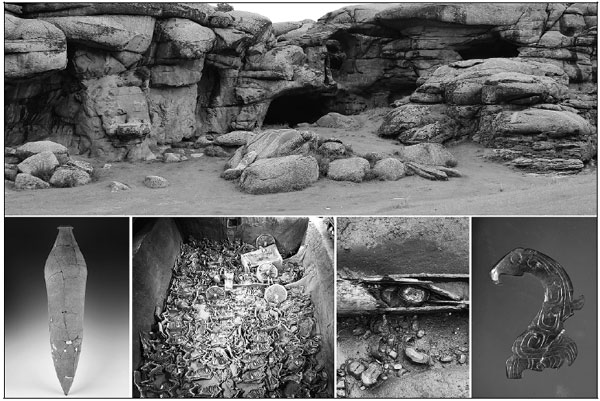
(Clockwise) Tongtiandong Paleothic site in Jeminay, Xinjiang Uygur autonomous region. A jade phoenix found at the Yaoheyuan site, Ningxia Hui autonomous region. A hoard used in silver transportation found at an ancient battlefield in Meishan, Sichuan province. Horse skeletons and chariots found in Xinzheng, Henan province. A bottle found at the Yangguanzhai site in Xi'an, Shaanxi province. Provided to China Daily |
(China Daily 04/11/2018 page5)
 Shandong Culture and Tourism Consumption Season
 Culture, tourism sectors pick up in Shandong as epidemic wanes