CLOTHING FIT FOR A PEOPLE
They feel more comfortable in voluminous robes than in a taut pair of jeans, and these advocates of a clothing style that goes back thousands of years are determined to ensure it remains with us for a long time yet
One Sunday afternoon a little more than 16 years ago, 17 men and three women who stood in a row at the Shanghai Science and Technology Museum were given a worldwide fanfare - and it was as much what they were wearing as what they had been talking about that grabbed the world's attention.
People's Daily reported that the main element was "a satin jacket featuring Chinese-style cotton buttons and round flower patterns with peonies surrounding the four letters of APEC, and a white silk shirt". They came in six colors, scarlet, blue, olive green, brown, burgundy and black.
Those who wore these jackets on Oct 21, 2001 were the leaders of the Asia-Pacific Economic Cooperation forum economies, holding their annual meeting in China for the first time since its founding 12 years earlier.
It had become the custom for the leaders to don traditional clothes of the host country on the final day of the forum, and speculation about what form this would take had become a popular guessing game. However, in China that guessing took a serious turn, with earnest debate about what, in this context, the term "traditional Chinese" could possibly mean.
The result was the tangzhuang, a hybrid based on Qing Dynasty (1644-1911) clothing and other, more modern, elements. A little more than 20 years after China began to open up to the world, and just three weeks before it became a member of the World Trade Organization, the aim of the forum organizers was apparently to highlight not only the country's traditions but its modernity as well.
Zhao Jianhua, in his book The Chinese Fashion Industry: An Ethnographic Approach, says that the tangzhuang became extremely popular after the APEC meeting, but that in essence it was a fad that lasted for little more than a couple of years, even if the garment has become a set piece in the Chinese wardrobe.
However, the creation of the tangzhuang and the debate surrounding it appear to have been the genesis of a movement whose members show no sign of being content for their preferred garb to be mere space fillers in a wardrobe. These are the aficionados of traditional clothing based on that worn by the country's ethnic majority, the Han, 5,000 years ago.
Though the term tangzhuang was deployed to describe the APEC jacket, there was no Chinese word in the early 2000s to denote clothing from the Han Dynasty, and the term eventually coined was hanfu (Han clothing). The irony is that what has led to a revival in this centuries-old style of clothing and that keeps the flame flickering is 21st-century technology - the internet and social networking.
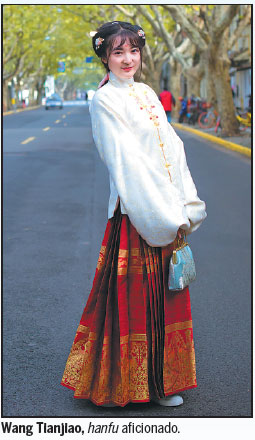
One aficionado of hanfu is Wang Tianjiao, 26, of Shandong province.
"Tieba is where I first learned about hanfu 11 years ago," Wang says, referring to the community online forum Baidu Tieba.
"I was absolutely spellbound by this time-honored clothing."
She realized that few of her acquaintances had heard of hanfu, and all the information she got about it came from Baidu Tieba and a website, where a movement to rejuvenate hanfu germinated.
The dress on which contemporary hanfu clothing is based appeared as long as 5,000 years ago and prevailed through different dynasties in Chinese history until the Manchu established the Qing Dynasty in 1644. The Qing regime banned the wearing of Han clothes, and for the masses the custom of dressing in such clothing gradually disappeared.
Four years after Wang came across the Baidu Tieba group, she attended a hair-pinning ceremony, a traditional rite that marks Han girls' passage into adulthood, at the Jinan Fuxue Confucius Temple, built during the Song Dynasty (960-1279) and restored as a tribute to Confucius in 2005.
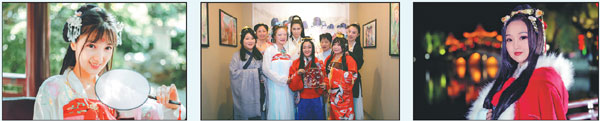
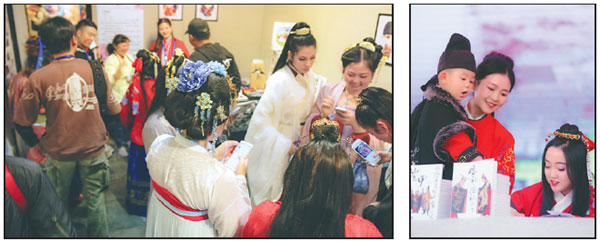
Such activities have frequently been organized by hanfu aficionados in recent years to promote the traditional culture and clothes of Han people.
Regional hanfu organizations have sprung up across the country. The annual Hanfu Cultural Festival held in the ancient scenic town of Xitang, Zhejiang province, draws more than 150,000 visitors. The event is streamed live by the online-broadcasting platform Yingke and in November is said to have attracted 167,000 viewers over four days.
Wang herself founded a hanfu club after enrolling at the University of Jinan in Shandong province in 2014. In preparation for its opening she and some friends donned quju, a type of hanfu with its right lapel wrapped around the body, and performed dance for the university's art festival. The background music was Chong Hui Han Tang ("Dating back to the Han and Tang dynasties"), the theme song sung by a singer called Sun Yi for the hanfu movement.
Wang says she encourages club members to wear hanfu on traditional Chinese festivals. For example, on every 12th of the second lunar month, or "flower festival" which, according to Chinese folklore, is the birthday of flowers, she holds ceremonies with her friends at Daming Lake in Jinan dressed, of course, in hanfu.
"I want to wear it in public so those who are curious about it or the traditional etiquette behind it can learn about it. The revival of hanfu is not about turning backthe clock or about cosplay. It's about passing down the culture of the largest ethnic group in China, which runs from way back to ancient times."
One aspect of passing on that message is making the most of the technology at her disposal, and Wang says she often takes photographs when dressing in hanfu and posts them on Sina Weibo, China's answer to Twitter. She has nearly 70,000 followers there.
A pioneer in promoting hanfu on the internet was the website hanfuhui, which Liu Yinhong, 27, set up four years ago and is said to now have more than 200,000 registered users.
Liu, of Shenzhen, was well placed to make the marriage between hanfu and new technology work, having earlier been a programmer for a software developing and having coded Web pages in his spare time.
"At that time, Tieba was the largest online community for those who love hanfu, and there was no website for it. I wanted to design a platform on which tongpao (a nickname for hanfu lovers) could share pictures, organize online activities and post articles, all about hanfu."
The site soon branched out into an online discussion board and shopping guide for all things hanfu. About 80 percent of the users are aged 18 to 28, Liu says.
"The term hanfu extends beyond clothes, covering other cultural treasures such as tea art, archery and the zither."
There are of course more traditional ways of propagating the hanfu lifestyle, such as on paper.
Chen Suyue, in a comic book called Jiao Ni Xue Guiju ("Teach yourself social etiquette"), has characters dressed in hanfu discuss in a humorous way how to behave appropriately on certain occasions, especially by adopting traditional social niceties that most people are unaware of.
Weaving culture and clothing into these stories makes them more interesting for people of different ages, Chen says.
Chen says she started working with the third Hanfu Cultural Festival in Xitang in 2015 and needed to learn about the standard shapes and structures of Han attire.
"I thought designing and painting the cartoon posters for the festival would be a synch, but the organizers saw things completely differently."
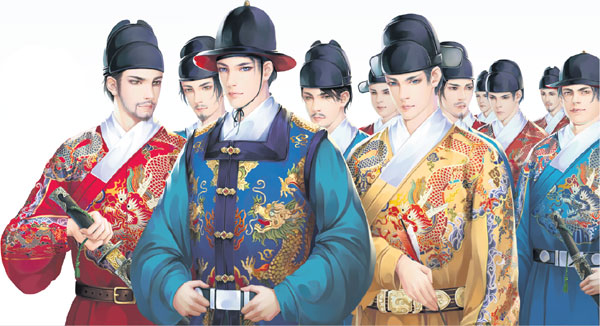
Just how difficult her job was became clear to her when she prepared the main illustration for the festival: 16 men in feiyufu, clothes worn by the imperial guards of the Ming Dynasty (1368-1644).
"There was so much detailed stuff I had to learn. The hats, the collars, the patterns. ?? I revised them again and again based on instructions from three hanfu experts."
Chen says the organizers' and experts' scrupulousness about every detail of hanfu impressed her, and she put hours into researching hanfu and then putting it to practical effect.
"I used to care only about whether the piece fitted me well or not. I couldn't name its type and didn't know anything about its cultural background. Three years of working with hanfu has turned me from a hanfu layperson into a real tongpao."
She is now a member of the organizing committee of the hanfu cultural festival and says it is a great opportunity to bring greater cohesion to the tongpao group nationwide.
"I have really been encouraged to see so many people who share my passion get together to dress in hanfu. Some tongpao traveled thousands of kilometers to take part. Some came with their parents and children and some worked as volunteers day and night, all because of the hanfu and its glamour."
Sometimes when Chen travels she wears her hanfu attire, and once when she went to Japan, some of the locals mistook her garb for Korean traditional clothing, she says.
"In my view, hanfu should be developed into a Chinese cultural symbol that can be given currency worldwide."
xingwen@chinadaily.com.cn
|
Han cultural activities have frequently been organized by hanfu aficionados in recent years to promote the traditional culture and clothes of Han people. Photos provided to China Daily |
|
Main illustration for the third Hanfu Cultural Festival in Xitang in 2015: 16 men in feiyufu, clothes worn by the imperial guards of the Ming Dynasty (1368-1644). |
|
From left: The Hanfu Cultural Festival held in the ancient scenic town of Xitang, Zhejiang province; Chen Suyue (right) at the festival. Photos provided to China Daily |
(China Daily 03/03/2018 page13)
 Shandong Culture and Tourism Consumption Season
 Culture, tourism sectors pick up in Shandong as epidemic wanes