Yantai - combining legacy and vibrancy along Shandong’s northern coast
"Smoke Tower" (yan tai), a curious name for one of China's most charming, most fascinating and certainly a very interesting city. Shandong Peninsula’s exposed coastline was targeted by 14th century pirate attacks. Beacon towers erected on hills warned of impending danger. Yantai’s former tower, protected by a small temple, remains today atop a delightful forest park (yantaishan) but now dominated by a tall, working lighthouse - the iconic symbol of this city strategically located where waters of the Bohai Gulf and Yellow Sea merge close to the Korean Peninsula and indeed Japan.
Although a small hill, Yantaishan is a tranquil coastal park with a truly commanding location. Looking north the view is of a vast modern port. Dominated by "Taisun" the world’s largest gantry crane crane at Yantai CIMC Raffles shipyard, there is constant movement and activity from large ‘roll on-roll off’ ferries connecting with Dalian; bulk carriers transporting minerals; smaller vessels connecting nearby populated islands.
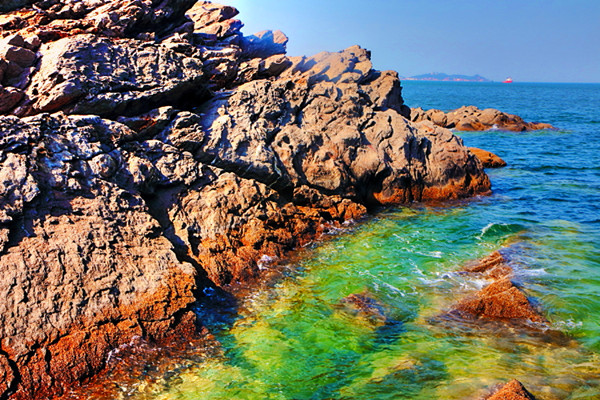
The park with its rocky coastline and garden landscape, popular for wedding photography, is also an historic learning experience. It is home to some of China’s finest and best maintained western-style villas. In 1861 Yantai opened to international commerce as a treaty port. Seventeen nations quickly established consulates with several including Britain, US and Denmark setting up on Yantaishan. Although no longer functioning diplomatically, the villas remain, serving as traditional teahouses or museums documenting this period in Yantai’s history. A replica of Copenhagen’s "Little Mermaid" rests in the former Danish Consulate’s garden.
The 1861 harbor with its original buildings and dockside paraphernalia can still be visited although today it is a yachting marina. However some of the city’s traditional maritime functions continue beyond the marina towards the railway station. Yantai remains a prominent fishing port with daily, timeless scenes of fisherfolk unloading sacks of shell creatures harvested from rocky offshore islands. Seafood markets bustle every morning with fresh catches. Stunning shells and conches sell from stalls at popular tourist locations. With easy access to abundant marine harvests, Yantai offers its own version of the Shandong’s fine cuisine experience.
Although Yantai was a ‘treaty port’ it did not have "foreign concession" areas such as Shanghai. It was known as "Chefoo" a name still present as "Zhifu" district. Originally a small close-knit town, the maze of surviving narrow alleys between Yantaishan and the early harbor are fascinating to explore. A wealth of domestic structures intermingle alongside more westernized architecture. Iron-balconied 19th/early 20th century apartments rise above stone-stepped hilly lanes reminiscent of Europe. Outside small low rise courtyards sprawled fishing gear reminds of the maritime heritage.
Yantai seems a perfect area to create historic walking tours for not only are the alleys a fascination to wander through but at every corner there is something new to discover such as the site of the early post bureau on Hai’an Street. As the town expanded from its original core, so a customs house was added, well-laid streets appeared, western churches opened and a large hotel started catering for resort-based tourism.
Running through the old town, repaved and partly pedestrianised Chaoyang Street attracts visitors to its outdoor cafes, seafood restaurants and "Druid"s’ Yantai’s first Irish pub - a street with much potential, a place to relax while considering the city’s story. To discover more, the Yantai Museum located in a former guild hall, is a good start.
Nestling directly east and below Yantaishan is the Golden Gulf Hotel - a distinguished establishment that has welcomed leaders from many countries and international organizations. Corridor walls are lined with photographs of an earlier Yantai. Westward it overlooks the magnificent villas of Yantaishan while its sea-facing windows demonstrate why visitors come to the city - spellbinding sunrise views over the sweeping bay; of islands dotting the horizon; of fishing boats heading out to sea; speedboats taking visitors around the harbor. Along the ocean-skirting promenade morning exercises are performed alongside men casting fishing lines from long rods into the incredibly clear waters. This is where visitors know they have entered an enchanting, alternative world far away from vast urban conurbations - a place for relaxation but also to discover a truly amazing city.
The promenade southeast from Yantaishan takes in much of what was earlier expanding Chefoo. Prominent older buildings along Guangren Road have been transformed into galleries: museums including Beijixing Watches Culture Museum: restaurants; cafe bars - a pleasant area to stroll where historical reminders such as the former Russian consulate contrast with the Yantai’s modern skyline rising towards Tashan and Nanshan.
Continuing past the bathing beach, and Yueliang Bay is a headland around which a tourist path includes a wooden plank suspension bridge; a seal enclosure and stunning views across to Kongtong Island - best appreciated from the Eastern Fort, accessed from the path and retaining large naval guns alongside older canons. Beyond, another bay sweeps past the Dongshan Trestle towards Haichang Fisherman Pier and ultimately towards Weihai. With its first class environment, beautiful vistas and clean air, this area could be perfect for developing cycleways - promoting cycle tourism from Penglai to Weihai.
There is more to Yantai than its beautiful scenery, there is wine! The area is famed for its wine culture. Vineyards surround the city. Close to Yantaishan is the well presented and informative Changyu Wine Culture Museum. Today not a production base, its vast cellars do store many large wooden fermenting barrels - the museum is also an excellent venue for some quality wine tasting. And after the wine, Yantai’s famed apples - over 200 varieties grown locally!
Yantai, the city has much to offer that brings people back and justifies its reputation for not only being one of China’s most charming but also one of its most friendly cities.
 |
|
Coastline of Yantaishan, May 2017. [Photo/Bruce Connolly] |
 Shandong Culture and Tourism Consumption Season
 Culture, tourism sectors pick up in Shandong as epidemic wanes