Tall ancestors found in Shandong tombs
JINAN - Archaeologists have found evidence of unusually tall and strong people who lived in East China 5,000 years ago.
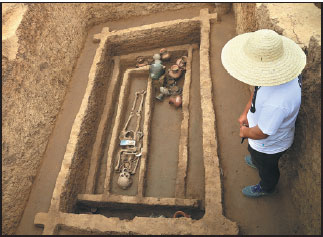
Measurements of bones from graves in Shandong province show the height of at least one man to have reached 1.9 meters.
"This is just based on the bone structure. If he was a living person, his height would certainly exceed 1.9 meters," said Fang Hui, head of Shandong University's School of History and Culture.
Since last year, archaeologists have been excavating the ruins of 104 houses, 205 graves and 20 sacrificial pits at Jiaojia village in Jinan, Shandong.
The relics are from the Longshan culture, a late Neolithic civilization in the middle and lower reaches of the Yellow River, named after Longshan mountain.
"Already agricultural at that time, people had diverse and rich food resources, and thus their physique changed," Fang said.
Millet was the major crop and people raised pigs, according to Fang. Pig bones and teeth were found in some graves.
According to the findings, taller men were found in larger tombs, possibly because such people had a high status and were able to acquire better food.
Shandong locals believe height to be one of their defining characteristics. Confucius (551-479 BC), a native of the region, was said to be about 1.9 meters tall.
Official statistics back up the claim. In 2015, the average height of men aged 18 in Shandong was 1.75 m, compared with a national average of 1.72 m.
Ruins of rows of houses in the area indicate that people lived quite comfortable lives, with separate bedrooms and kitchens, according to the excavations.
Colorful pottery and jade articles have also been found, said Wang Fen, head of the Jiaojia excavation team.
The area was believed to be the political, economic and cultural center of northern Shandong 5,000 years ago. Ruins of ditches and clay embankments were also found.
The Jiaojia ruins fill a cultural gap 4,500 to 5,000 years ago in the lower reaches of the Yellow River, according to Wang Yongbo of the Shandong Provincial Institute of Archaeology.
Archaeologists found obvious damage to the head and leg bones of some of the bodies and to pottery and jade articles in six large tombs. The damage may have been caused not long after the burials and may be due to power struggles among high-ranking people.
Li Boqian, an archaeologist with Peking University, said the excavations showed Jiaojia in a transition phase, but proved the existence of ancient states 5,000 years ago in the basin of the lower Yellow River.
The size of the Jiaojia site has been quadrupled to 1 square kilometer. Currently, only 2,000 square meters have been excavated.
"Further study and excavation of the site is of great value to our understanding of the origin of culture in East China," said Zhou Xiaobo, deputy head of the Shandong Bureau of Cultural Heritage.
Xinhua
|
The archaeological site in Jinan, Shandong province, where the skeleton of an unusually tall man was found.Jiang Li / For China Daily |
(China Daily 07/05/2017 page5)
 Shandong Culture and Tourism Consumption Season
 Culture, tourism sectors pick up in Shandong as epidemic wanes