Shandong man holds on to ancient art form
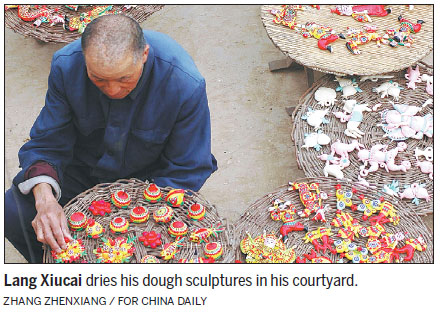
With his rough yet deft hands, Lang Xiucai in Langzhuang village of Liaocheng, Shandong province, has created a variety of dough sculptures. Yet facing his creations, the villager, now in his 80s, looks downcast.
"They were popular in the early 1980s, especially during holidays, but now few people ask about them," Lang told Liaocheng Daily.
The Langzhuang dough sculpture, or "Dough Tiger" as locals prefer calling it, is a traditional folk art form that was listed as a national intangible cultural heritage item in June 2008. It is facing extinction due to a lack of successors.
The art form dates back to the Ming Dynasty (1368-1644), when brothers surnamed Lang from nearby Shanxi province moved to the village.
As the village's name Lang has the same pronunciation as the Chinese character for "wolf", villagers began to make tigers out of flour, hoping to dispel any possible bad luck with the fearsome figurines.
Lang Xiucai began to learn the sculpture trade from his uncle at the age of 14. With more than 60 years of creative experience, he was designated one of two inheritors for the village. The other, Li Baoshan, passed away when he was approaching 70, some 10 years ago.
Traditionally, the shapes of the statues were not limited to just tigers, and were often made in the likeness of birds, flowers, fish and insects in small sizes, from 3 to 5 centimeters. They were painted in bright colors to attract the eyes of children, Lang said.
Later, larger-sized subjects of 20 to 30 cm, such as figures from traditional Chinese opera and ancient myths, were produced to meet market demand, locals added.
Langzhuang villagers profited from the Dough Tiger craftsmanship, which was long considered a family secret and shared only with the craftsmen's sons. In its heyday, every family in the village was involved in the business.
With the art form as the main source of income, Langzhuang was known as a wealthy village even after the war ended in 1949. Proceeds from a Dough Tiger of 0.5 kilogram could pay for 1 kg of flour back then. "While neighboring villages could hardly afford flour, steamed buns were commonplace in our village," Lang recalled.
China's reform and opening-up started in late 1970s, giving the traditional craftsmanship a new lease on life. Lang said he sold more than 3,000 dough sculptures within three days for a total of 300 yuan ($44) in Hebei province in 1983, slightly lower than the country's average annual net earnings per capita, 310 yuan. Buyers were drawn to the village and placed orders for dough sculptures packed in gunnysacks.
Yet the traditional craftsmanship is now in a tight corner, as it is facing a shrinking market and a shortage of successors.
After senior villagers with the expertise passed away, few young people showed interest in the handicraft and its meager earnings, Lang said.
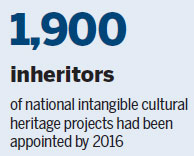
The Ministry of Culture appointed more than 1,900 inheritors of national intangible cultural heritage projects by 2016, more than half of those still living are older than 70, according to a recent report released on the ministry's website.
Local authorities are campaigning to promote the Dough Tiger art form in schools. In a local primary school, more than 70 students have joined a dough sculpture group and receive Lang's training.
Sun Yulian, a paper-cutting enthusiast, began to learn from Lang in 2008 and tried to innovate the flat sculptures with standing forms and more colors.
Lang said: "The one to lead the craftsmanship and make it flourish might be one such young enthusiast."
(China Daily 02/23/2017 page17)
 Shandong Culture and Tourism Consumption Season
 Culture, tourism sectors pick up in Shandong as epidemic wanes