Rescuing Mount Tai's Painting Traditions
Fortunately for Zhang and his contemporaries, this is not a struggle they will have to undergo alone. In recent months, Tai'an Municipal Bureau of Culture, Radio, TV, Film, Press and Publication released a statement announcing their concern and highlighting Shuilu's importance for research into religious culture, folk-customs, clothing, and art history of Mount Tai. This concern was symbolized by Shuilu becoming an intangible cultural heritage in March 2016.
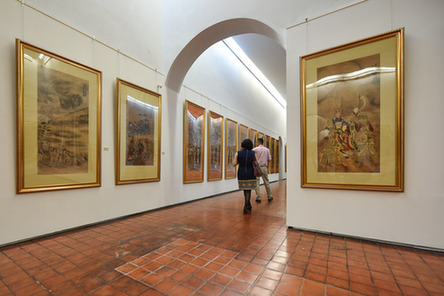
While the function of these paintings has shifted in modernity, from one of a highly religious nature to one that might be considered more of a cultural practice, the subject matter and layout has undergone less dramatic transformations. Works typically depict god figures and their subjects with a display of bright colors and intricate small-scale portraiture. As the Tai'an authorities indicate, the works display social values across a long time span and, due to the artistic push towards realism, give a valuable insight into contemporary trends in fashion and customs.
 |
|
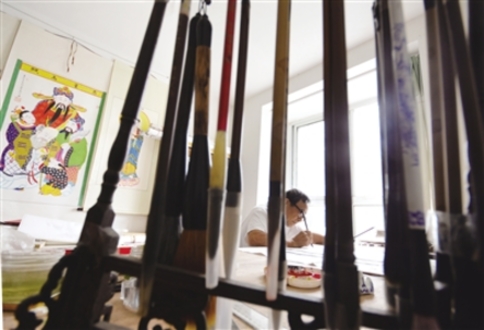
Zhang Gongshi is a passionate devotee of Shuilu paintings and often spends a whole week on a single piece. [Photo/tarb.cc] |
A constant feature of Shuilu paintings is a mobility that has led to the description 'moveable murals' by art historians. Yet one fascinating change is the variety of surfaces that have been used. Although Zhang now paints on rice paper, it was silk that dominated during the Tang and Song Dynasties (AD 618-907 & AD 960-1279) and paper scrolls that were predominately used from the Yuan (1271-1368) through to the Qing.
It was during China's last two dynasties that Mount Tai established painting workshops that formalized a semi-official style, one type that Zhang eventually engaged with and mastered. These local workshops of artists mass produced religious images, which had become popular commodities for Buddhist centers and affluent private interests. The speed of these Ming and Qing artisans stands in opposition to Zhang who claims to be capable of producing one painting a week, provided he can work six hours a day.
It is certainly fair to say that as with his artistic forefathers, Zhang has committed his whole life to creating Shuilu; he began painting at the age of six and attended university to study mechanical drawing, which taught him skills certainly evidenced in his artistic endeavors. The fact he didn’t complete his own Shuilu painting until the age of 22 indicates the scale of technical proficiency required for Shuilu painting.
 |
|
Chinese Shuilu paintings on display in Thailand, a Buddhist country in Southeast Asia. [Photo/xinhua] |
The future pathway of Shuilu painting may be as uncertain as the Buddhist road to enlightenment but Zhang is not yet despairing. In fact, he has found promise in the hands of someone rather close to home; his granddaughter, a high school senior endowed with a blossoming talent.
Edited by Richard Whiddingdon
 Shandong Culture and Tourism Consumption Season
 Culture, tourism sectors pick up in Shandong as epidemic wanes