
A family art
 |
|
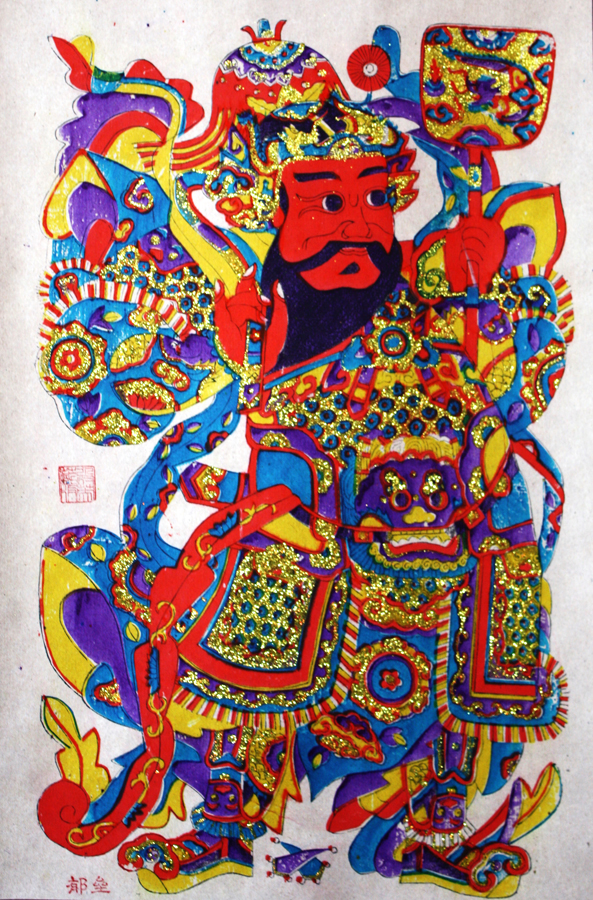
A Yangjiabu New Year painting features a traditional Chinese Menshen(Door God ) named Yu Lei, who could drive ghosts and evil spirits away according to ancient legends. [Photo provided to chinadaily.com.cn] |
With 300 families, Yangjiabu has been making woodblock-printed New Year paintings since the Ming Dynasty (1368-1644). It is now one of China's three production centers of traditional folk paintings, together with Tianjin's Yangliuqing and Suzhou's Taohuawu.
Local government records show that the village can produce 210 million single-sheet prints a year, which are sold across the nation and to countries such as Russia, Japan, South Korea and Singapore.
These paintings are no longer mere decorations for the Spring Festival, they are also fine works of art sought by international collectors.
"However, compared with the village's heyday 200 years ago, when nearly 300 workshops and stores flourished, the figure today is very small," says Wang Yonghai, head of the Weifang municipal research institute on Yangjiabu New Year paintings.
Chinese people tend to decorate their homes with New Year paintings during the Spring Festival, to ward off evil spirits and bring good luck to the family throughout the whole year.
The origin of New Year paintings can be traced back to the Tang Dynasty (AD 618-907). The legend goes that Li Shimin, the second emperor of the Tang Dynasty, often had nightmares about ghosts. Then he asked an artist to paint portraits of his two bravest generals and paste them on to the door to guard him through the night, and his nightmares stopped.
The artist who painted for the emperor is said to come from Yangjiabu. When he returned to his hometown, many people asked him to make the same painting, and so "door gods" were created, and are still the most common subjects of Yangjiabu New Year paintings.
The themes of Yangjiabu paintings cover a wide range of topics, from folk religion, auspicious symbols, historical personages, myths and legends, to current affairs, local customs and landscapes.
"They are all based on the lives of the people and sometimes are also used to express various sentiments," Wang says.
A typical painting once widespread during the Ming Dynasty, for example, portrays the story of Emperor Zhu Yuanzhang, founder of the dynasty, showing his ministers how to plow the fields. The picture was trying to persuade the emperor to stop his despotic rule and develop production.
"Yangjiabu painting stands out with its rich use of bright color, rough lines, exaggerated images, and full composition. It is pure and down-to-earth, and it is especially favored among the Chinese public," says Wang.