Artworks capture struggles of Red Army in Long March
(chinadaily.com.cn)
Updated: 2016-12-27
 |
|
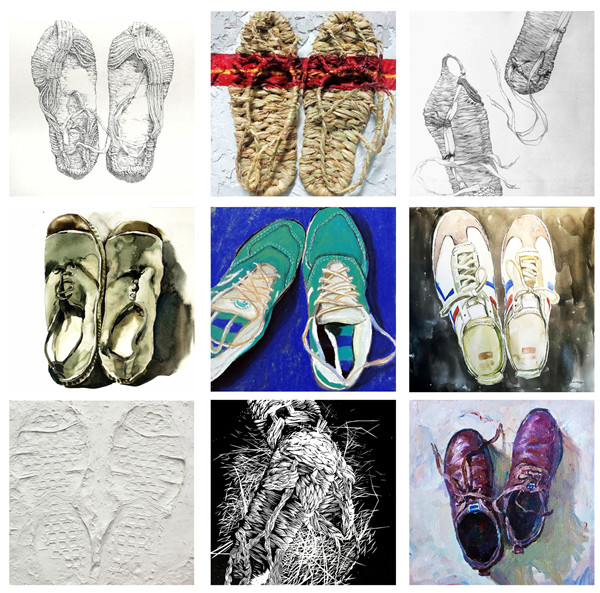
Journey and Footprints, an artwork by a group of students from the Central Academy of Fine Arts. [Photo provided to China Daily] |
The high-altitude Ruoergai Grassland in northern Sichuan province attracts tourists today for picturesque wetlands and diverse wildlife. More than 80 years ago, however, the scene was less tranquil-the Red Army fighting against harsh terrain and weather during the Long March, a military retreat the Communist Party of China conducted from 1934-36.
Historical records show the grassland claimed some 10,000 Red Army soldiers, who died of illness, starvation, coldness and other reasons.
Last September, Zhang Lujiang, a professor of Beijing's Central Academy of Fine Arts, and a team of young teachers and students, visited Red Army sites in the area. They spent two weeks retracing the route that Red Army soldiers undertook to survive the hostile natural environment while finding a gateway to the north to evade the Kuomintang army's pursuit.
Zhang's team returned to Beijing's studios and painted a group of oil canvases, titled Red Army's Recipes, which are now on show at a grand exhibition at the capital city's National Art Museum of China.
Art Rally of the Long March shows dozens of artworks in various mediums, including paintings, sculptures, animations, videos and designs, which artists at the CAFA produced over the past year to reinterpret the spirit of the Long March.
Teachers and students worked in groups to retrace some of the routes.
The exhibition is the latest of several shows since last year to mark the 80th anniversary of the completion of Long March.
It provides viewers novel perspectives and experiences to reflect what Red Army soldiers endured to realize their revolutionary ideals.
Red Army's Recipes feature eight main categories of food that sustained the life of soldiers: grass roots, tree bark, wild herbs, wild fruits, fungus, leather belts, highland barley and little meat.
"Lack of food was, of course, most difficult for the Red Army when trekking on the plateau. They relied heavily on grass roots and chewing tree bark helped to ease their desire to eat," says Zhang. "Many died of poisonous wild herbs, fruits and fungus."
He says the Red Army bought highland barley from local Tibetans and lamas, and after they ran out of money, they left debt notes for loans of grains that are preserved today at local museums.
He says his team tried to cook food in the wild as the Red Army did. The rice couldn't be cooked well because of the terrible weather and atmospheric pressure in high-altitude areas.
"I tried a kind of carrot that Red Army soldiers once picked to eat. Within seconds, I felt great pain in my throat. Local Tibetans say only pigs eat the carrots," he says.
"These paintings are not regular still lifes produced in classrooms. We intend to recall those memorable, extraordinary years."
Fan Di'an, president of the CAFA, says the exhibition is also relevant to the present and the future, and the spirit of Long March as a core of national morale should rally generations of artists.
The exhibition therefore incorporates a cross-disciplinary perspective.
Students from the fashion design department were inspired by the Red Army's uniforms and the attire of ethnic groups living along the Long March routes to create the works.
Visitors put on helmets, and virtual-reality technologies are applied to bring the audience into a fighting scene in which soldiers advance on a chain bridge amid intense fire.
A group of eight people from the art education department sent painting tools and books to primary schools in Sichuan's Aba Tibetan and Qiang autonomous prefecture. They taught students there to paint stories of the Red Army. They brought back some 100 paintings that are also on show at the current exhibition, juxtaposed with another 100 paintings by Beijing primary school students.
Students from the experimental art department have animated some of these paintings, and turned them into a 15-minute-long video work and nine installations.
Song Xiewei, the exhibition's curator and a professor of the CAFA's urban design department, says the rich experiences and narrative feature of this exhibition show how to engage modern-day viewers to cherish the heritage of the Long March.
If you go
9 am-5 pm, closed on Mondays, through Jan 4. 1 Wusi Street, Dongcheng district, Beijing. 010-6400-1476.
What we do
SAFEA is responsible for certifying foreign experts to work in the Chinese mainland and organizing overseas training for Chinese technical and managerial professionals.