|
|
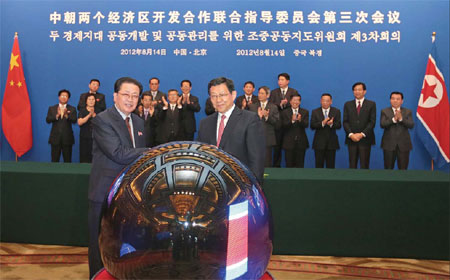
Commerce Minister Chen Deming (R) and Jang Song-thaek, director of the central administrative department of the Workers' Party of Korea, mark the start of an administrative committee for the Rason, Hwanggumphyong and Wihwa Islands economic zones in the DPRK in Beijing on Tuesday. Jang's six-day visit aims to improve economic relations between the countries. Li Baojun / for China Daily
|
Manufacture and trade areas seen as key to improving lives
A meeting in Beijing this week of officials from China and the Democratic People's Republic of Korea offers the chance for further development of Chinese border cities in two China-DPRK economic zones, Chinese experts say.
The two special economic zones are the result of an official visit by the late DPRK leader Kim Jong-il in 2010.
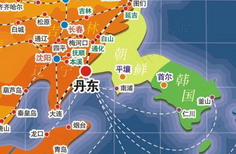
One is the Rason Economic and Trade Zone in northeastern DPRK that is adjacent to Yanbian, in China's Jilin province. The other one is the Hwanggumphyong and Wihwa Islands Economic Zone near the estuary of the Yalu River and adjacent to Dandong, in China's Liaoning province.
China and the DPRK signed agreements on Tuesday in the meeting on setting up and running a management committee, on economic and technical cooperation, agricultural cooperation, power transmission, park construction and detailed planning in the Rason Economic and Trade Zone, the Chinese Ministry of Commerce said.
Chen Jian, vice-minister of commerce, said in an article in the People's Daily on Tuesday that "China and the DPRK are heralding an era of opportunities to deepen economic cooperation and jointly develop economic growth".
According to the General Administration of Customs, China-DPRK trade amounted to a record $5.67 billion (4.62 billion euros) last year, an increase of 62.4 percent, also a record, on 2010.
In the first half of this year bilateral trade was worth $3.14 billion, 24.7 percent higher than for the corresponding period last year.
After the China-DPRK meeting, the stocks of most listed companies from Jilin province rose about 5 percent on Wednesday. Analysts suggested the DPRK's economic measures are giving impetus to the performance of these listed companies.
"When there are consistent economic policies to support the development of special economic zones, local companies and industries will be strongly inclined to help the area develop," said Piao Jianyi, a research fellow on Korean issues at the Chinese Academy of Social Sciences.
According to the joint management agreements, the two sides have done the planning that will help with progress in establishing mechanisms, training personnel, compiling detailed plans, laws and regulations, making customs clearance easy, establishing telecommunications links, and working together in agriculture and on building projects.
Huo Jianguo, president of the Chinese Academy of International Trade and Economic Cooperation, a think tank linked to the Ministry of Commerce, said more bilateral cooperation can help the DPRK alleviate poverty and tackle its economic woes.
The economic development of Dandong, on the China-DPRK border, is intimately related to trade between the two countries.
Piao said Dandong stands to gain a lot from government and private investors as the development drive in the economic zones goes on because the demand for top-flight human resources and advanced technology will increase.
"Dandong has a long history of light industry which happens to be the major businesses that will be developed in the special economic zone. By upgrading industrial clusters and technologies, border cities like Dandong will be able to achieve great things under the joint development."
Piao said Rason's joint development is beginning from a high point, much higher than that for an economic plan that the DPRK initiated a few years ago.
Under the development agreement, the Rason Economic and Trade Zone will focus on developing light industry, industries dealing in raw materials, industrial equipment and high-tech, the service industry, and modern and efficient agriculture.
And the economic zone will gradually be built into an advanced manufacturing base in the DPRK, an international logistics center for Northeast Asia as well as a regional tourist center.
"In the past, Rason was identified as a DPRK processing center but the plan went no further because of a shortage of resources and skilled workers," Piao said. "But with this new plan Rason will be able to play an important role for peace and prosperity in Northeast Asia."
Under the agreements, the Hwanggumphyong and Wihwa Islands Economic Zone will be built into an intelligence-intensive emerging economic zone by focusing on developing information, tourism, cultural and creative industries.
"The Hwanggumphyong and Wihwa Islands have rich farmland and important food sources," Piao said. "Switching from traditional agriculture into modern industries shows how determined the DPRK is to develop its economy."
Zhang Liangui, an expert on Korean Peninsula studies at the Party School of the Communist Party of China Central Committee, said that while the Rason development is important for the DPRK, the country has said its basic policy will change little.
The spokesman for the Committee for the Peaceful Reunification of Korea said on July 29 that there cannot be the slightest change in any policy of the DPRK because the policies are meant to advance and accomplish the ideas of past leaders, according to the official KCNA news agency.
"The DPRK leadership may adjust specific approaches according to changes in the internal and external environment," Zhang said. "But seeing adjustment as reform or opening up has no basis in fact."
The 50-strong DPRK delegation was led by Jang Song-taek, chief of the central administrative department of the Korean Worker's Party.
In the Republic of Korea, the national newspaper Chosun Ilbo said Jang's visiting fueled speculation that the DPRK leader Kim Jong-un will travel to Beijing soon.
But Piao said the interpretation is mistaken.
"High-level official visits between China and the DPRK are always undertaken by political parties rather than government agencies. In meeting China's Minister of Commerce Chen Deming, Jang's task is economic development."
Previous DPRK leaders visiting China had inspected programs not necessarily applicable to their country, such as the Three Gorges of the Yangtze River.
But in the last two trips of the late DPRK leader King Jong-il he focused on the development of the provinces in Northeast China. The latest delegation has been working on practical development in the border area.
"Building a stronger economy is one of the DPRK leadership's main jobs, which also reflected in how their visit has been organized," Piao said.
zhaoyanrong@chinadaily.com.cn
(China Daily 08/17/2012 page3)
|