



Lofty Lushan Mountain
Temples in Hidden Places
On the First of August
Wheels by the Water
Share your travel story with regional@chinadaily.com.cn

Ganzhou
( travelchinaguide.com, Wikipedia, chinadaily.com.cn )
Updated: 2011-08-15
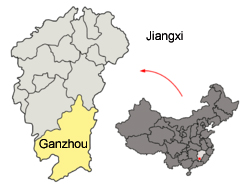
Location of Ganzhou within Jiangxi
Location: Ganzhou is a large city covering the southern end of Jiangxi province, with an area of 39,400 square kilometers. It borders Hunan province to the west, Guangdong province to the south, and Fujian province to the east, as well as the cities of Ji'an and Fuzhou to the north.
Physical features: More than 70 percent of the area is forested. Mountains and hills are the predominant types of landform of Ganzhou city, covering a percentage of eighty of the city's territory. Several of the major tributaries of the Ganjiang River, Ganzhou's namesake, join at a confluence in the center of the city.
Climatic features: Enjoying a subtropical humid monsoon climate, the city has abundant rainfall. Intense precipitation usually begins in May. Boiling days in summer and chilly days in winter are relatively fewer. The annual average temperature is about 19 ℃?(66 ℉).
Demographics: According to the official website of Ganzhou People’s Government, there are 8,969,900 people living within prefecture limits. More than 99 percent are Han Chinese, and 71,200 people belong to 41 minority ethnical groups (mainly She, Hui and Yao).
Ganzhou also contains the largest Hakka community in Jiangxi province. Almost all the people in Ganzhou speak Hakka except the urban area, which is considered as a Southwestern-Mandarin-speaking "dialect island".
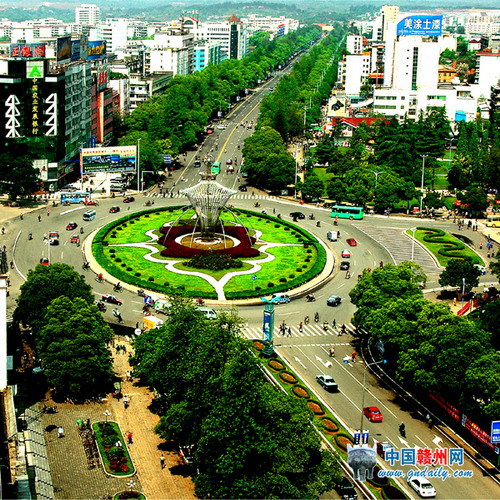
South Gate Culture Plaza in Ganzhou city
Brief history: Human settlers moved to this region four or five thousand years ago. Before the Qin Dynasty (221-206 BC) put it under the administration of Jiujiang Shire, Ganzhou was a part of the Chu Kingdom in the Warring States Period (476-221 BC). By the Three Kingdoms Period (220-280 BC), a city-level administrative apparatus had been established, which is said to be the initiation of city-level governing bodies in southern Jiangxi.
Ganzhou is one of the famous old revolutionary areas in China, and used to the locus of the Central Revolutionary Base and the Chinese Soviet Republic temporary government. Many Chinese proletarian revolutionists, including Chairman Mao Zedong and Premier Zhou Enlai, took part in revolutionary activities in Ganzhou. The world-famous Long March started from Ganzhou. Numerous revolutionary historical sites are preserved in the city, among which Ruijin, the Red Old Capital, is the most famous.
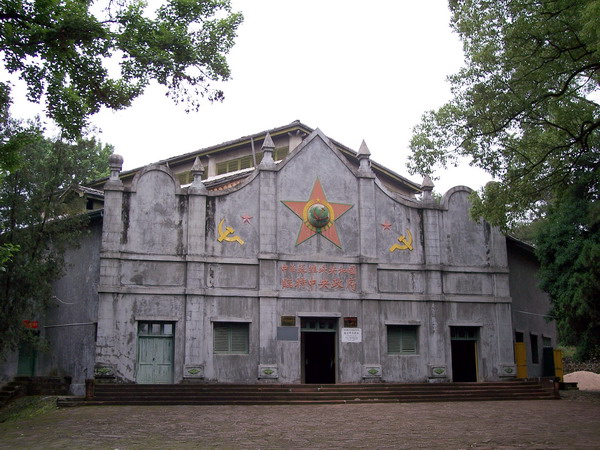 |
| Ruijin Central Revolutionary Base Area Memorial Hall |
Ganzhou was proclaimed as the national level historical and cultural city by the People’s Republic of China on January 4, 1994.
When to go: spring and autumn
Special local products: southern poplar mushroom, konjak, orange, tea, red melon seed
Scenic spots: Ganzhou is known as the "Orange Capital of the World" as well as the "Tungsten Capital of the World". The world's largest mechanical clock is located in Ganzhou called the Harmony Clock Tower.
Famous scenic spots in Ganzhou mainly include Sanbai Mountain in Anyuan county, Jiulian Mountain in Longnan county and the Post Road at the Meiguan Pass in Dayu county. Sanbai Mountain is the origin of the Eastern River; Jiulian Mountain is the most complete section of sub-tropical natural ecosystem with numerous living fossils of wildlife are preserve, and has been listed as a key nature reserve under the protection of Jiangxi province.
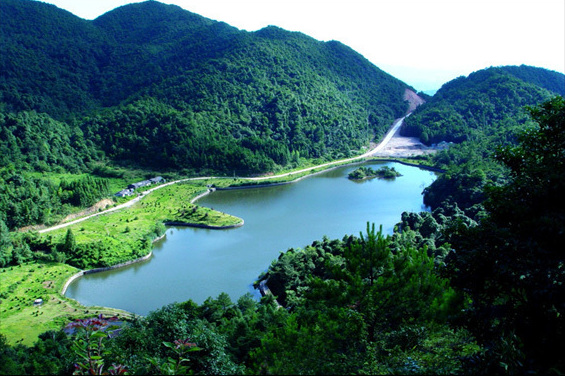 |
| Fubie Pond on Sanbai Moutain scenic area |
Tourist tips:
1. Ganzhou Huangjin Airport is seated in the south outskirt of Ganzhou, only 4 kilometers (2.5 miles) from the city proper. At present, it has opened flights to Guangzhou, Beijing, Jingdezhen, Nanchang, Chongqing, Nanjing and Shanghai. The new airport is under construction in the Nankang city and it is expected to be accomplished at the end of 2007.
2. Ganzhou Bus Station lies in No 25, 814 Avenue, Zhanggong District, dispatching 600 buses a day. Here list some express bus routes from Ganzhou.
To Nanchang, about once an hour, 4.5-hour drive
To Guangzhou, about eight buses daily, 5.5-hour drive
To Shenzhen, about 4 buses daily, about 5-hour drive
