From surviving to thriving
( China Daily )
Updated: 2012-06-07
|
|||||||||


|
Pan Jinfeng is a migrant worker-turned-provincial congress delegate in Zhangjiagang. Provided to China Daily |
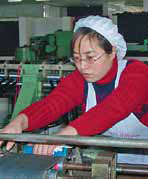
When Pan Jinfeng came to Jiangsu province's Zhangjiagang city with just 30 spare yuan 19 years ago, she never imagined she would one day become a provincial congress delegate.
"I came here to survive," she says. "Not to follow my dreams."
Pan went to Zhangjiagang in 1993 after a fellow villager from the outskirts of Jiangsu's Suqian town told her it was a decent place to work. The sixth and youngest child of her family wanted to improve her household's situation.
"My hometown has continued developing very slowly," Pan says. "I wanted to change our family's lives because the conditions were miserable. So I came here."
But her position as a delegate enables her to improve the lot of more than just her family. "I only cared about my own affairs before I became a representative. I should find ways to help migrants and give them hope. I know they also come from places with poor local conditions," she says.
She became the first migrant worker to join the congress in January 2008. Her term lasts five years.
"Jiangsu has 9 million migrants. I'm one of them," Pan says. "So I feel a heavy responsibility. Because I'm a migrant, too, I know what they really need. If there's no migrant representative, nobody can address our issues."
Her most significant proposals that have passed enable Jiangsu's migrant workers' children to take the university entrance exams (gaokao) in whatever cities the parents work in the province. Her proposal for migrants from the province passed in 2009 and another version for migrants from outside Jiangsu followed. The rule is pertinent to her family, as her 10-year-old son attends primary school in Zhangjiagang.
Pan was a kindergarten teacher before she moved to Zhangjiagang. The school in her village was poor and often gave her IOUs rather than cash on payday so she had very little money when she arrived at age 18. She set off with 100 yuan ($16) and only had 30 left after paying for her train ticket and daily necessities.
"Lunch cost 1 yuan. It was two meats, one vegetable and a soup," she recalls. "But I still thought it was expensive. I tried to send every yuan I could earn to my family."
She then earned 300 yuan a month and sent 250 home. But money wasn't her only hardship.
"I couldn't understand the dialect then, so I felt like an outsider and became very homesick," Pan says. "But many people helped me. My accent is still different from locals' but I don't feel like an outsider anymore."
Pan's life has, indeed, improved. She earns more than 3,000 yuan a month at Zhangjiagang Pukun Textile Co, where her hard work earned her promotions and awards. She was among the first 1,000 people to join the company, which now employs 3,000. The plant also provides a library with 50 computers and thousands of books on such topics as democracy. When Pan started, five women lived in a dorm and every floor shared a toilet. Now, every room has a TV and restroom. Pan's 140-sq-m house cost 80,000 yuan. The company provides such subsidized housing for model workers. She relocated to northern Jiangsu with her husband, whom she met through a company matchmaker in Zhangjiagang in 2001, after her company started a joint venture closer to her hometown.
It used to take more than 24 hours to travel between Zhangjiagang and her hometown. But a new highway has cut the time to three hours. She returns to her village every Spring Festival. Otherwise, she spends weekends with co-workers and their families in parks. It's her rapport with colleagues that earned her many workplace honors.
He Xia recalls meeting Pan in 1994. "Pan is proactive, open-minded and warm," He says. "She taught and helped me a lot as a young worker."
He says Pan trains many new recruits and resolves conflicts among women workers. She recalls Pan once asked a woman who seemed unhappy what was bothering her and learned the woman's husband died in a car accident. Pan organized colleagues to raise money for her.
It was partly Pan's problem-solving abilities that led Zhangjiagang to select her as a provincial congress delegate.
"Because I'm a migrant, I can address problems and the government acts immediately," Pan says. "There are some migrant issues people haven't been able to solve. But I can."