|
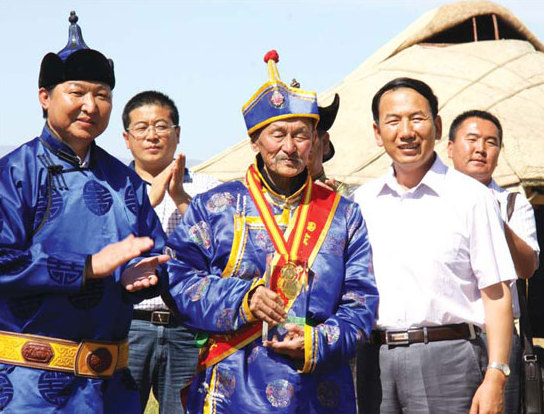
Hoboksar Party Secretary Xue Junqiang (right) and government head Caibugejiafu (left) grant an award to a Jangarqi. Jangarqi refers to artists who devoted their lives to spreading the Jangar epic and art. |
|
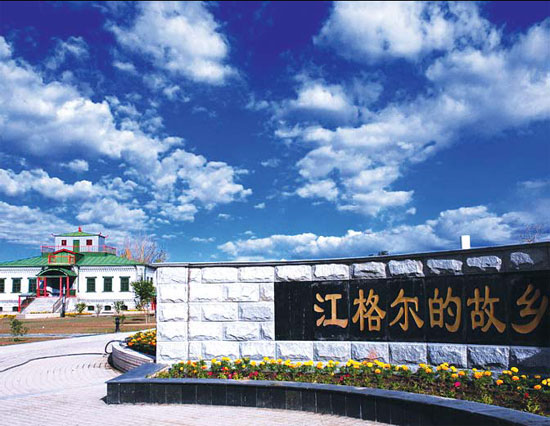
The Hoboksar Mongolian autonomous county is considered the birthplace of Jangar. |
|
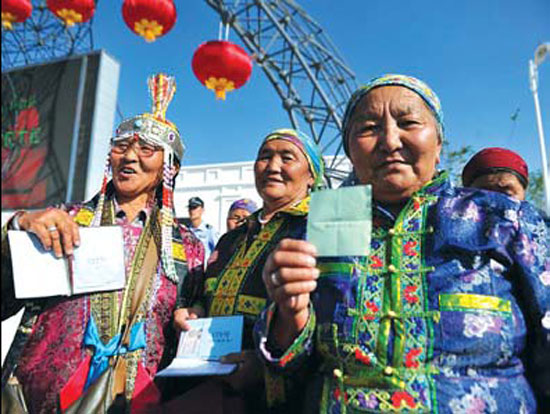
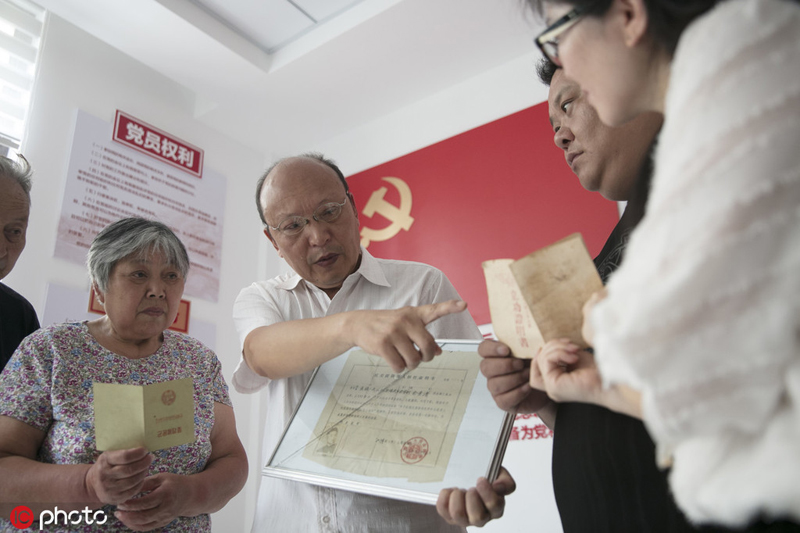
Hoboksar locals hold certificates entitling them to relocate to government-funded houses. |
Birthplace of unique Mongolian art looks to past, lays foundations for future
The government of Hoboksar Mongolian autonomous county, a small county in Xinjiang with a long history, is increasingly focusing on the "spiritual well-being" of the local people by drawing on its rich cultural traditions, its top official said.
"The core value of our cultural system is peaceful, diversified and harmonious living for the people," said Caibugejiafu, head of Hoboksar county.
Jangar culture
Because Hoboksar is the birthplace of Jangar culture, a unique form of Mongolian storytelling and dance dating back to the 15th century, the county government has prioritized the preservation of these traditions.
Jangar is one of China's most important ethnic art forms. The epic dance mostly hinges on the depiction of a battle between Mongolian hero Jangar and the evil warlord Mangus.
Performances, art shows, festivals and symposiums are held in the county throughout the year to help carry on this unique cultural legacy.
In 2011, domestic and foreign scholars and experts on Jangar culture were invited to take part in research on the county's cultural development.
The Jangar School was established in 1999 at the Menggeng Bulake village to train young Jangar performers. The curriculum combines such ordinary school subjects as math and literature with two classes of Jangar singing and dance training for an accumulated six hours a week.
The county's authorities have also endeavored to ensure elderly performers in the region pass down their skills to the younger generations by inviting them to teach at training centers in the county's villages.
Local performers also cooperated with counterparts in Beyinguoleng and Bortala Mongolian autonomous prefectures in Xinjiang to successfully put a representative Jangar work on China's intangible cultural heritage list.
"The county is named the 'the birthplace of Jangar', but most locals, especially the youngsters, can't say what Jangar is. So, protection of the traditional culture is much needed," said Caibugejiafu.
Collected evidence shows that the Jangar epic in Hoboksar may date back to the 17th century. There are more Jangar legends in Hoboksar than in any other place, and of the 60 chapters of the Jangar Epic published in the Mongolian language, 40 were collected from the county.
"Actually, the traditional culture in the county is closely related to people's daily life. Thus, improving the livelihood of locals has become a vital part of our cultural development," said Xue Junqiang, Party chief of the county.
Enrich rural life
The county, 495 km from Urumqi, capital of the Xinjiang Uygur autonomous region, has a total of 63,000 people from 19 ethnic groups, with Mongolians dominating the population.
The county is rich in 30 sorts of mineral resources, with reserves of crude oil, natural gas, coal, salt and limestone surpassing 100 million tons.
The county is also rich in agriculture and animal husbandry resources. There are six nationally certified organic agricultural and livestock production bases, which occupy a total area of 795,000 hectares. It is the country's first organic livestock production county.
"We have a small population but rich resources. Everyone here is supposed to have a rich life. It's our responsibility to make them live in peace and harmony," said Xue.
In 2011, the county's GDP reached 2.2 billion yuan, a growth of 23.5 percent from 2010. The income per capita for local farmers and herders also increased 1,000 yuan from a year ago.
"The rich resources provide financial support to the county's cultural development," said Xue. "Also with support from the Xinjiang government, the cultural development in the rural areas of the county has made great progress."
"Most of the cultural stations in villages and towns were established in 1980s. The total area of rural cultural sites was less than 1,000 sq m. And now, with greater supports in recent years, the total area for such sites has reached 4,307 sq m," Xue added.
In 2011, Xiazigai township invested 453,000 yuan to set up a 413 sq m cultural center equipped with a reading room, ballroom, cinema and fitness equipment.
At present, the average number of books in a rural cultural site is 40,000. And most of the sites have been equipped with entertainment, music and sports facilities.
The cultural stations also hold performances, exhibitions and sports activities for locals. According to the county's statistics, more than 9,000 performances and exhibitions were held in the stations in 2011.
Cultural industry
"The cultural industry is a new booming industry," said Xue. "During the period from 2006 to 2010, we have invested a total of 23.8 million yuan in developing the cultural industry and building the public cultural system."
In 2007, the county's artists composed a four-act musical of the Jangar epic. First performed in the Inner Mongolia autonomous region as a part of cultural exchanges, the show was met with great acclaim.
In 2009, a 10-member juvenile Jangar arts troupe went to Germany, Austria, the Czech Republic, Slovakia and Hungary for performance tours. They also took part in the Vienna International Youth Music Festival and won the Best Performance Award.
In 2010, two digital movies - The Sound of the Moon and Jangarqi - were produced based on local culture. Seven series of Jangar books were also published, which have greatly promoted the popularity of the county's culture.
Contact the writers at maoweihua@chinadaily.com.cn
|
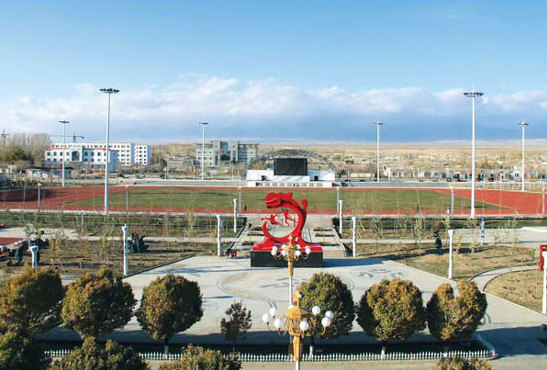
A sports field at the county seat provides locals a healthy way to spend their leisure time. |
|
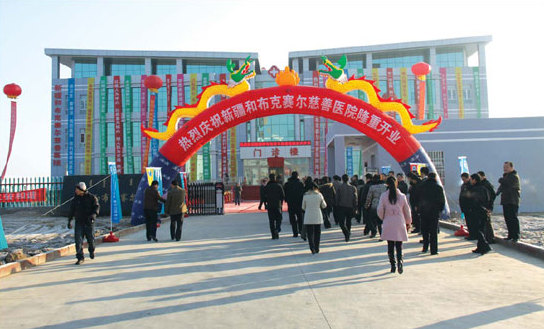
The newly opened Hoboksar Charity Hospital has become a new landmark in the county and a sign of the local government's growing focus on improving people's lives. Photos provided to China Daily |
(China Daily 11/09/2012 page17)