Mongolian wrestling
 |
|
Boke, the Mongolian word for wrestling, has a history of more than 2,000 years. |
Year:2006
Sort:Acrobatics & Sports
Area:Inner Mongolia Serial
No.:Ⅵ-16
Declarer:Inner Mongolian Autonomous Region
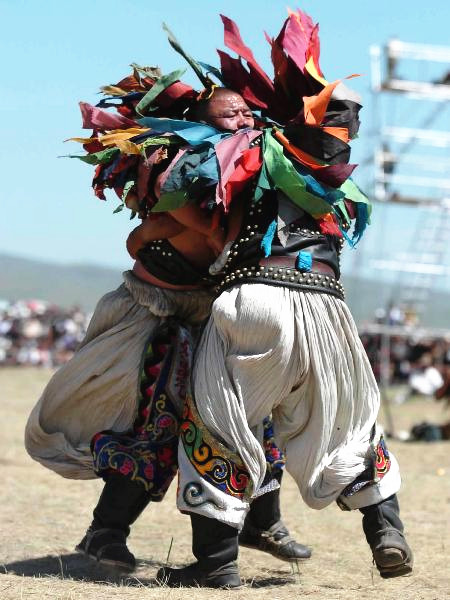
Boke, the Mongolian word for wrestling, has a history of more than 2,000 years. It is a rugged hand-to-hand sport, relying more on raw physical power than a wide variety of techniques, loved by Mongolian athletes, scholars and statesmen for its unique combination of athleticism and aesthetics.
Ⅰ. Origin
Boke is one of Mongolia's age-old "Three Manly Skills" (along with horsemanship andarchery).
The basic premise behind Boke is to force an opponent to touch any part of their body other than the feet to the ground, placing them in a position of inferiority. This kind of training served the Mongol hordes well in their conquests, earning them a reputation as fierce soldiers on foot and on horseback.
It was this type of military might that allowedGenghis Khanto Conquer China at the end of the Song Dynasty in 1127. Genghis Khan considered wrestling to be an important way to keep his army in good physical and combat shape. Boke was also used occasionally as a way of eliminating political rivals. The Qing (1646-1911) Manchu imperial court held regular wrestling events, mainly between Manchu and Mongol wrestlers.
Ⅱ. Features
The Mongolian way of wrestling is different from bothChinese wrestlingand sumo wrestling in Japan. It is distinguished from other ways by its rules, methods, uniforms and fields. There is neither a separation of grade (no age or weight distinction) nor a fixed number -- as long as the match has even numbers of participants such as two, four, six, eight, sixteen, thirty-two, sixty-four or one hundred and twenty-eight. All the wrestlers are matched by arrangement or by drawing straws. The judges enjoy high prestige and command universal respect. The game is single- elimination - if a player loses once, he's out. The loser is not allowed to compete again. Half of the people are eliminated with each round.
As soon as the judge gives an order to start, the opponents first shake hands to show respect to each other, and then begin wrestling. There is no time limit, and the opponents can use any method or moves they want, such as pulling, kicking, tripping, pushing, holding or lifting. However, holding your opponent's legs, arbitrarily kicking, or pulling down his trousers is not allowed. Whoever touches the ground with any part of his body above the knees loses.
Awards are given to both contestants. The loser receives his award first, the winner second. No one goes home empty-handed. The first place in boke is an achievement the Mongolians don't take lightly. Not only will they weigh him down with prizes like golden cups, scarves and other artistic works - but he'll receive a live camel as well. In addition, the champion will greatly increase his chances of getting married. After all, a Mongol isn't considered a real man unless he wrestles.


 Baotou, China