'Eight treasure congee' shines during Laba Festival
By Zhao Xiao (chinadaily.com.cn)
Updated: 2017-01-05
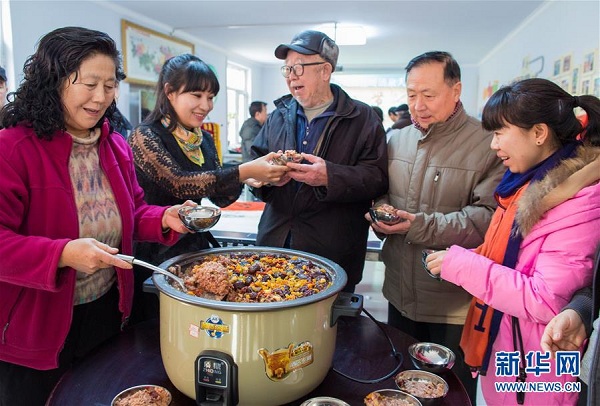
A group of community volunteers served the elderly with spoons of Laba congee to warm up before the upcoming festival in the Qingquan community of Yuquan district, in Hohhot, capital city of North China's Inner Mongolia autonomous region, on Jan 4.
Falling on the eighth day of the twelfth lunar month in the Chinese calendar, the Laba Festival is centered around eating Laba congee, or eight treasure porridge, which is usually made with at least eight ingredients, representing the people's prayers for a good harvest, happiness, and peace.
 |
|
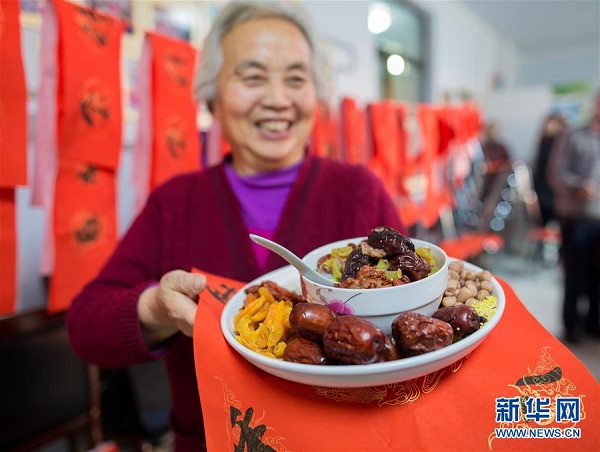
An old woman presents the ingredients of Laba congee to journalists at the Qingquan community of Yuquan district, in Hohhot, capital city of North China's Inner Mongolia autonomous region, on Jan 4. [Photo/Xinhua] |
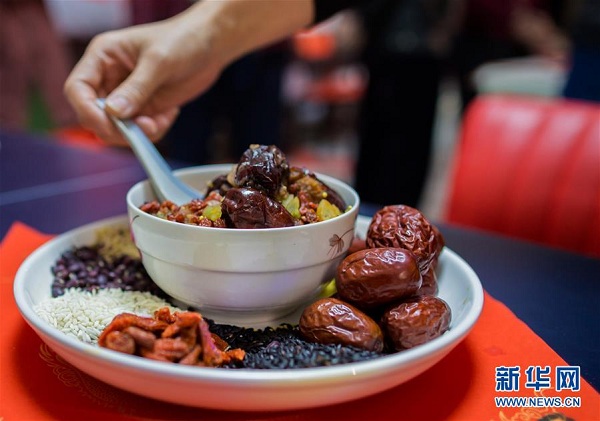
The earliest form of this dish was cooked with red beans and has since developed into many different kinds. It is mainly composed of rice along with other grains, but can contain dried fruit, nuts, colorful beans, red dates, peanuts, lotus seeds, longans, wolfberry, and more. Depending on the region in China, it can also include tofu, potatoes, meat, and vegetables.
Laba Festival was originally an occasion for people to present sacrifices to their ancestors or to worship the gods and spirits to pray for the harvest and luck for their family. Many years later, it has become a Laba congee eating event. In ancient China, the congee was widely consumed throughout China by not only the common people, but also government officials and aristocrats. In the imperial court, the emperor and nobles often gave Laba congee to the officials, servants, and others.
 |
|
This photo shows the ingredients of Laba congee at the Qingquan community of Yuquan district, in Hohhot, capital city of North China's Inner Mongolia autonomous region, on Jan 4. [Photo/Xinhua] |
The twelfth lunar month is called 'La' in Chinese and eight is pronounced 'ba', which is how the name 'Laba' was derived. It is not only regarded as a day of sacrifice, but also the day on which Sakyamuni (founder of Buddhism) realized truth and became a Buddha.
Laba porridge is now regarded as a very nutritious food during the winter that has the function of strengthening the spleen, stimulating the appetite, and soothing the nerves. It is welcomed by all people of different ages.
There is a Chinese proverb "If Laba Festival comes, Spring Festival cannot be far behind", which indicates the Chinese New Year is approaching and people are ardent for a break with family gatherings and holiday celebrations.
 |
|
Volunteers dish out Laba congee for the elderly living at the Qingquan community of Yuquan district, in Hohhot, capital city of North China's Inner Mongolia autonomous region, on Jan 4. [Photo/Xinhua] |

High-speed train debuts in Inner Mongolia
A bullet train departed Hohhot East Railway Station for Ulanqab marking the start of high-speed rail services using Inner Mongolia’s first newly-laid high-speed railway on Aug 3.