Mongolian man on a musical mission
By Chen Nan (China Daily)
Updated: 2015-07-31
"My father let me try to play it, and I remember I just couldn't stop playing it for the whole night."
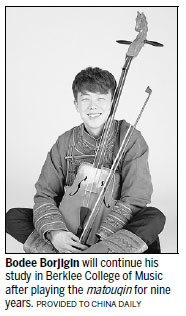
Since that heady introduction to playing the ancient matouqin, or horse-head fiddle, nine years ago, when Bodee Borjigin was 9 years old, his infatuation for the most important musical instrument of the Mongolian ethnic group never seems to have waned.
"I'm never tired of the matouqin," he says. "For me it's an instrument on which you can play any kind of music, ancient or contemporary."
Borjigin has just returned from Ulan Bator, the Mongolian capital, to Hohhot after performing with the Wild Horse Ensemble, a group from the Inner Mongolia autonomous region founded by the established contemporary matouqin player Chiborag nearly 30 years ago. The ensemble is made up of a dozen of Mongolian ethnic musicians, including Onelltu, the band's chief player.
The ensemble, celebrating Mongolia's summer festival known as Naadam, performed three works, including Chiborag's popular composition Thousands of Horses Galloping, in an event in Chinggis Square in downtown Ulan Bator on July 13.
"Many other artists performed at the festival, including hip-hop groups and pop and rock singers," Borjigin says. "I can feel that the sounds of the matouqin are part of all of us."
Even if Borjigin's recollection of the first time he played the instrument is crystal clear, he says he cannot recall exactly when he first encountered it because almost everyone in his family plays the instrument in their spare time.
He grew up listening to Khoomei (Mongolian throat singing) and Mongolian long song, a traditional style of singing in which performers take huge, deep breaths to sustain loud, extended phrases. He began to study playing the matouqin soon after that first highly memorable hands-on encounter with the instrument.
Though Borjigin attended a Mandarin-speaking school and, like his peers, enjoyed Western pop music, the matouqin is something all of its own.
He enthuses not only about its sounds but also about what he sees as its aesthetic beauty with its long, thin neck, a trapezoidal body, two soft nylon strings and a carved horse-head-shaped decoration on top.
Borjigin was introduced to Chiborag, who besides playing the matouqin and composing music for it, is one of its keenest promoters, in 2006.
Borjigin practiced more than 10 hours a day, and Chiborag persuaded Borjigin's father to let his son become a professional player.
"My father is no good at expressing his emotions, but I could feel his pride and excitement when he saw me playing the matouqin," Borjigin says.
When Borjigin was 16, he traveled to Beijing and studied the instrument at Minzu University of China, a top institution especially for students of ethnic groups.
Longing for home, Borjigin says, he began composing music to express his homesickness. On the instrument he also plays classical pieces written for the cello and the violin.
"Borjigin is one of the most talented young matouqin players in the country," Chiborag says. "He learns from traditional music, digests it, and can then write his own works."
In Beijing, Borjigin says, many musicians from Inner Mongolia, such as Hanggai, a rock band, and Haya, a world music group, blend Mongolian folk music with modern styles. These groups are popular at outdoor music festivals and live house venues across the country.
"More audiences are curious about the instruments, the voice and the language of Mongolian music. They are beginning to enjoy it," Borjigin says.
"But I believe that with Mongolian music, especially the matouqin, there is much more to it than is readily apparent to audiences. I want to make the kind of music that people will listen to again and again and that will draw them deeper and deeper into Mongolian culture."
Borjigin is taking his mission to spread the good word about the matouqin out into the greater world. In September he will go to Boston, where he has been accepted for a course in musical composition at Berklee College of Music.
"The good thing about studying abroad is that you can meet people and get a different vision about music," he says.
"The bad thing is that I have to leave my musical roots behind. But as long as I have my matouqin with me, I will be able to communicate with people from different cultures, and that will take me closer to my dream."
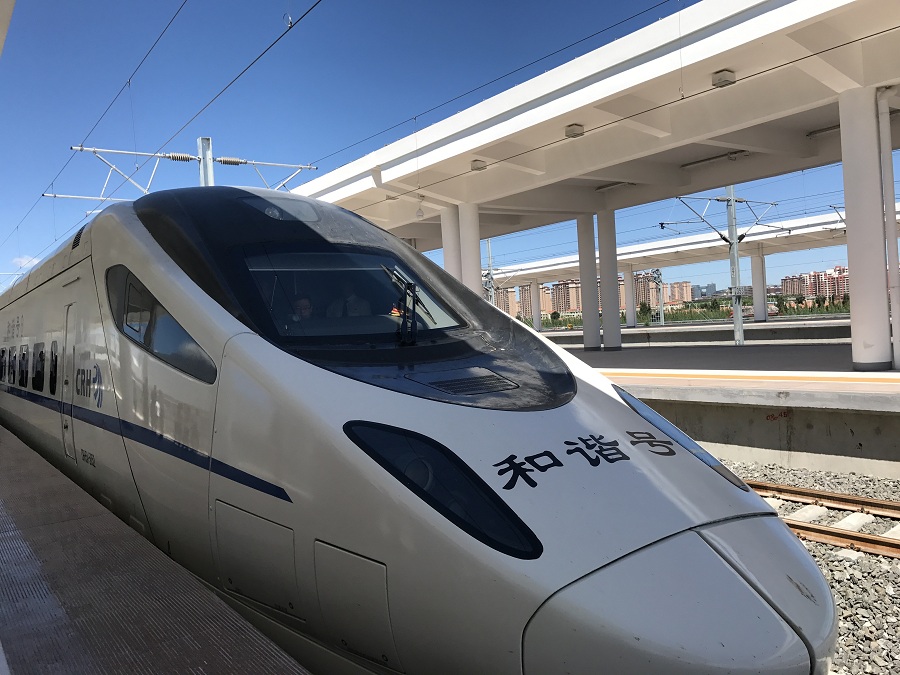
High-speed train debuts in Inner Mongolia
A bullet train departed Hohhot East Railway Station for Ulanqab marking the start of high-speed rail services using Inner Mongolia’s first newly-laid high-speed railway on Aug 3.