Mining the main reason for shirking lakes in Inner Mongolia
(chinadaily.com.cn)
Updated: 2015-05-13
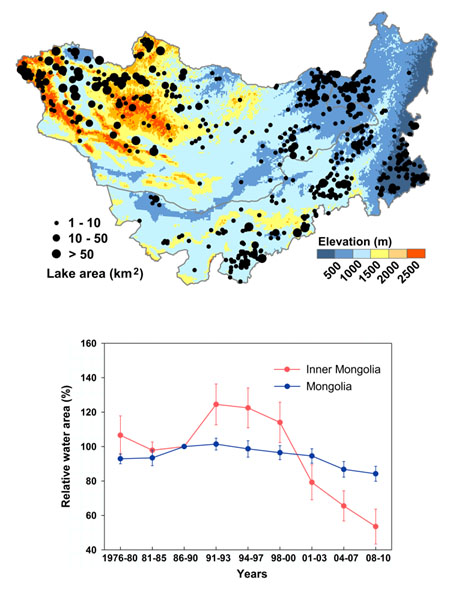
The total area of lakes in North China's Inner Mongolia autonomous region shrank by 30.3 percent in the past 30 years, according a research report published in the US journal Proceedings of the National Academy of Sciences.
 |
|
A chart shows the changes of lake numbers and areas from 1976 to 2010 in Inner Mongolia and Mongolia. |
A research team led by Fang Jingyun, an academician of the Chinese Academy of Sciences and Peking University, authored the report Rapid Loss of Lakes on the Mongolian Plateau, based on remote sensing interpretation and field study.
The team's research covered all the lakes on the Mongolian Plateau, both in Inner Mongolia and Mongolia, which showed the lakes were shrinking sharply in the past years.
The researchers monitored all the lakes with areas larger than 1 square kilometer on the Mongolian Plateau, and the number of lakes dropped from 785 in 1987 to 577 in 2010.
"The number of lakes in Inner Mongolia dropped by 145, accounting for 34 percent of the region's total, while the lakes in Mongolia decreased by 63, accounting for 17.6 percent," said Fang.
Inner Mongolia's total area of lakes was 4,160 square kilometers around 1987, this figure dropped to 2,901 in 2010.
In the short a term, a lake's expansion and shrinkage is the result of climate change and human activity, according to an assistant researcher from Inner Mongolia Agricultural University.
Fang's research showed the causes of shrinking lakes in Inner Mongolia and Mongolia were different. The change in lake area in Mongolia was attributed mostly to rainfall. However, this factor only accounted for 20 percent of the shrinking lakes in Inner Mongolia.
The research explained that the lakes on Inner Mongolia's grasslands shrunk majorly due to mining, which accounted for 64.6 percent of the shrinkage. In the region's farming and pasturing areas, water consumption of irrigation was the top cause of lake area reduction.
Human activity has lead to tremendous negative effects to the region's lakes. Fang's team appeals the central and local governments to put forward policies and plans to regulate the utilization of mineral and water resources in North China for this region's sustainable development.
Fortunately, measures have been implemented to stop the shrinking in Inner Mongolia. For example, the regional government together with the Hulunbuir government has established the administration committee of Hulun Lake national natural reserve, aiming to upgrade ecological protection through management, comprehensive treatment and system construction.
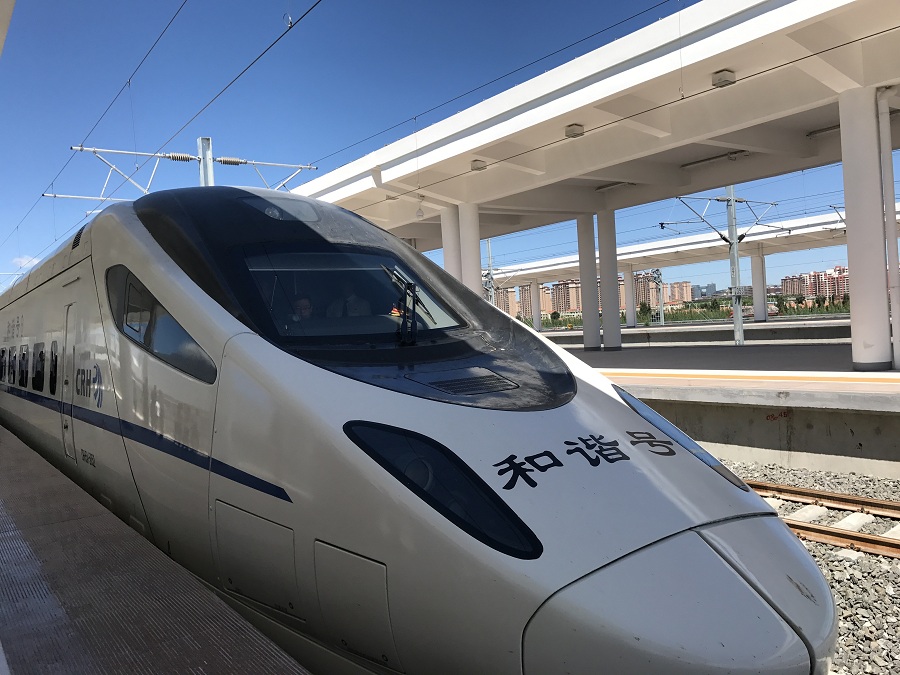
High-speed train debuts in Inner Mongolia
A bullet train departed Hohhot East Railway Station for Ulanqab marking the start of high-speed rail services using Inner Mongolia’s first newly-laid high-speed railway on Aug 3.