Discoveries offer fresh look at Silk Road history
By Wang Kaihao (China Daily)
Updated: 2015-04-14
 |
|
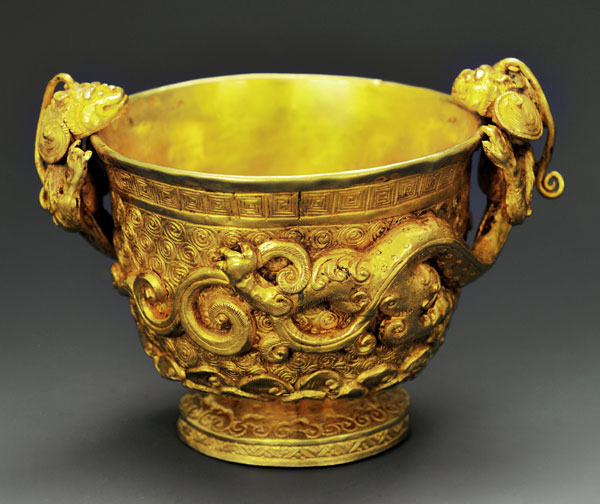
Gold cup with sacred animals [Photo provided to China Daily] |
In the Inner Mongolia autonomous region, a Northern Wei Dynasty (AD 386-534) tomb that was discovered last year also provided hints of a "grassland Silk Road", a scholastic term to describe the frequent exchanges among different civilizations along the trade route across the Mongolian grasslands and the Gobi Desert.
That dynasty was made of the nomadic Xianbei people, who according to scholars encouraged free mixing among different ethnic groups at the time. Articles including glass vessels from the Roman Empire, religious artifacts from Central Asia and silverware from West Asia, were found among the relics.
"It reflects the inclusive nature of Chinese civilization," Liu says, adding that it is among the most important archeological findings in China's northern borders in recent times.
The discovery of a tomb complex in Ngari in the Tibet autonomous region, unveiled the previously unknown ancient state of Xiangxiong, thought to have existed during the Han Dynasty.
"Surprisingly, the cultural relics unearthed in the tombs are more from Central Asia than from adjacent India," Liu says, adding that it opened more possibilities for Silk Road linkages.
"Some voids in historical studies of Tibet are also filled," he says.
The Silk Road remains a hot topic for public discussion in today's China, where government efforts are being made to establish closer cooperation with countries along the ancient routes.
Another tomb complex found in Zunyi, Guizhou province, seemed to show it belonged to a tribal chieftain's family from the Bozhou regime.
"The relics are uncommonly well-preserved," says Wang Wei, director of Archeological Society of China. "Technically advanced methods in labs are also used during the research. It allows archeologists to scrutinize details, which can sometimes be missed outdoors."
Wang, also a member of the judging panel, adds that with the discoveries a new trend in Chinese archeology is emerging. Previously, the country's archeologists tended to neglect relics after the Tang Dynasty (AD 618-907).

High-speed train debuts in Inner Mongolia
A bullet train departed Hohhot East Railway Station for Ulanqab marking the start of high-speed rail services using Inner Mongolia’s first newly-laid high-speed railway on Aug 3.