The challenge of eco-transition
By Asit K. Bi Swas and Zhang Jingru (China Daily)
Updated: 2014-10-08
Besides, not all environmental issues are receiving equal attention. Much of the focus seems to be on air and water pollution because it can be readily felt. By the end of 2012, says China's Law Society, 344 provincial and city level stations had been established to monitor pollution, mostly air and water pollution. But other forms of pollution - such as soil and noise pollution - get much less exposure in the media even though they could pose bigger (and/or long-term) threats to human health. For example, a nationwide survey on soil pollution in April 2014 indicated that 20 percent of China's farmland is contaminated by heavy metals. This has major food safety and human health implications.
Statistics from an environmental agency in Shanxi province show that as much as 40 percent of environment-related complaints are against noise pollution. In Shanghai, the figure is much higher, 48 percent. High-decibel noise from the streets is considered most annoying. Such noise could emanate from traffic or social activities, such as loud music that accompany street dancing by senior citizens. But not enough decibel monitors have been installed to detect the real noise levels, and residents' complaints are now the main way to identify sources of noise pollution.
The regulations on waste disposal are also a cause for concern. China is the final destination of 70 percent of global electronic waste such as batteries and mobile phones. This is not only because of the low labor cost in China, but also because of the lack of strict environmental laws to effectively dispose of such hazardous wastes. Again, the problem of waste management surfaces only when a serious incident takes place.
At the macro-policy level, China has indeed taken all the right moves. But how well these policies will be translated at the micro levels will depend on how well they are implemented. As the old English saying goes, the devil is in the details.
Asit K. Biswas is the distinguished visiting professor, Lee Kuan Yew School of Public Policy, Singapore, and co-founder of Third World Centre for Water Management, Mexico. Zhang Jingru is a doctoral student at the same school.
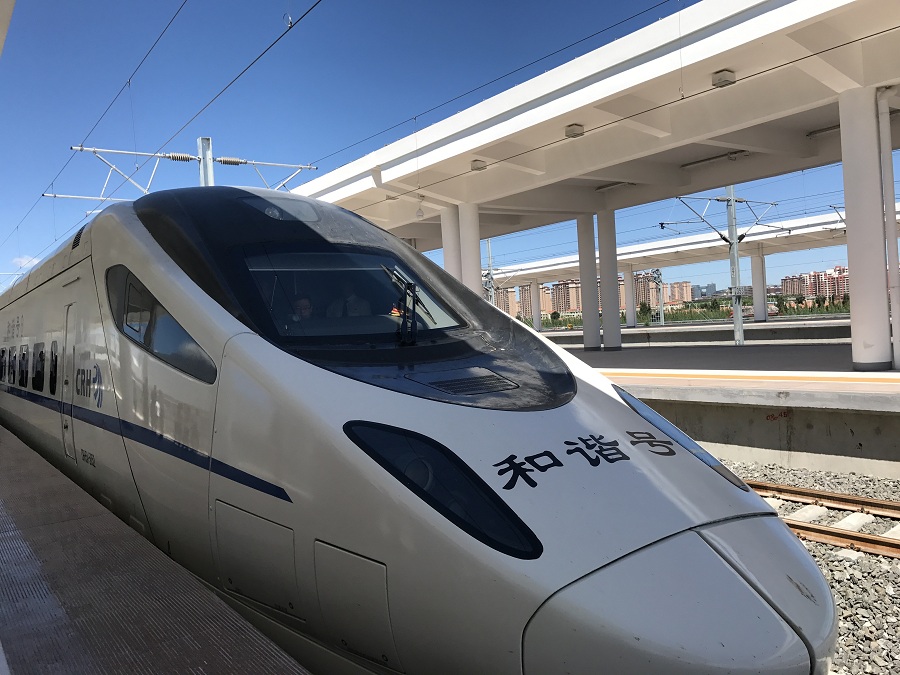
High-speed train debuts in Inner Mongolia
A bullet train departed Hohhot East Railway Station for Ulanqab marking the start of high-speed rail services using Inner Mongolia’s first newly-laid high-speed railway on Aug 3.